Casa Padellàs (Barcelona History Museum MUHBA)
Local history museum · Barri Gotic ·

Casa Padellàs (Barcelona History Museum MUHBA)

Local history museum · Barri Gotic ·

Walkable Roman ruins beneath exhibits, free audio guide

roman ruins
underground tour
ancient city
history of barcelona
barcino
free sunday
audio guide
roman empire
Casa Padellàs (Barcelona History Museum MUHBA) by null

Information

Pl. del Rei, s/n, Ciutat Vella, 08002 Barcelona, Spain Get directions

Restroom
Wheelchair accessible entrance
Wheelchair accessible restroom

Information

Static Map

Pl. del Rei, s/n, Ciutat Vella, 08002 Barcelona, Spain Get directions

+34 932 56 21 22
barcelona.cat

Features

•Restroom
•Wheelchair accessible entrance
•Wheelchair accessible restroom

Last updated

Dec 23, 2025

Powered By

You might also like

Terms of Use • Privacy Policy • Cookie Policy
 © 2026 Postcard Technologies, Inc.
@ricksteves
703 Postcards · 219 Cities

Barcelona Travel Guide by Rick Steves

"▲  One-stop trip through town history, from Roman times to today." - Rick Steves' Europe

https://www.ricksteves.com/europe/spain/barcelona
Casa Padellàs (Barcelona History Museum MUHBA)
@nomadicmatt
6,681 Postcards · 1,173 Cities

The 30 Best Things to See and Do in Barcelona (Updated 2025)

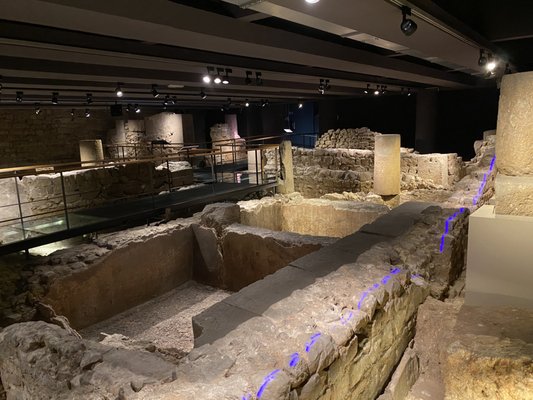
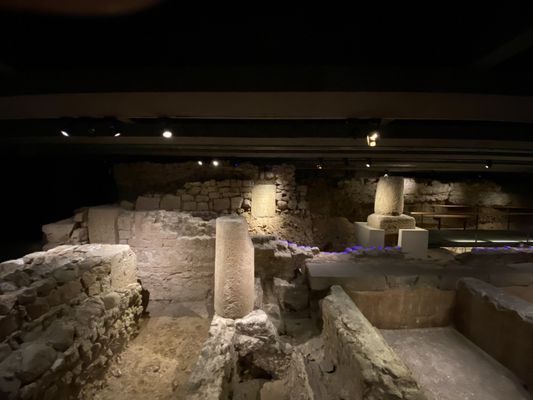
"Opened in 1943, the museum houses over 4,000 square meters of Roman ruins you can walk through underneath the building; there is a free, detailed audio guide and meticulous exhibit explanations, and even if you’re not a history buff you’ll get a lot out of it—the ruins really are amazing." - Matthew Kepnes

https://www.nomadicmatt.com/travel-blogs/things-to-see-and-do-in-barcelona/
Casa Padellàs (Barcelona History Museum MUHBA)
@nomadicmatt
6,681 Postcards · 1,173 Cities

Barcelona Itinerary: How to Spend 3-5 days here in 2025

"I consider this one of the best city history museums I've ever visited: it includes 4,000 square meters (43,000 square feet) of walkable Roman ruins beneath the exhibits, offers a free, detailed audio guide, and has meticulous explanations — I visit every time I'm in Barcelona because the ruins are just stunning." - Matthew Kepnes

https://www.nomadicmatt.com/travel-blogs/barcelona-itinerary/
Casa Padellàs (Barcelona History Museum MUHBA)

Breno M.

Google
Ok, honestly, this is the best museum I ve been in my life. I am not overreacting. I spent 3 days there. Literally. I went on three different sundays last year and I still haven't seen everything. I cried at the ruins. Everything is so well preserved and cared of. The elevated paths, the descriptions. I love the contrast between the sections of the museum. Classic Barcino, Medieval Barcelona, Modern Barcelona... Amazing! And to know I aquired so much knowledge... for free (the museum is free on sunday). One of the best things about this city is the amount of museums.

G M.

Google
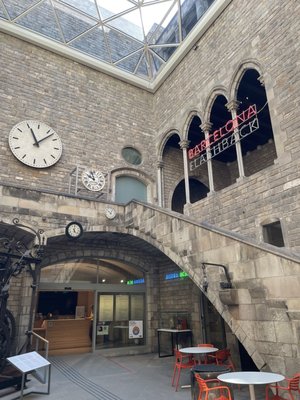
This is an absolutely brilliant museum. I only had an hour and could easily have spent 2 or more. The first part of the tour “flashback” is a fantastic potted history and is well curated and so interesting. You then head upstairs to the views outside over the plaza. Wonderful! Then you take the lift ( which is not well signed , clearer directions would help) to the ancient remains underground. So intriguing and the walkway is so well constructed with glass areas. It was a little confusing and I had issues finding the exit. Again clearer and more signs would help. Finally tou go to the church which is lovely with a wonderful altarpiece. Well worth the admission price.

John Robbie C.

Google
An excellent museum. We visited for free as it was the first Sunday of the month, however, it is well worth the €8 entry fee. Lots of history here, dating back to the Romans of Augustus' time, when the city was a small Roman settlement called Barcino. Easily spent over an hour here and highly recommend for those with an interest in the history of Barcelona.

Amin M.

Google
It is a great place to learn about the Roman history in general and the history of Barcelona in particular. The museum is designed according to historical records. The visitors explore history through different layers of excavation, each belonging to a different period. It start from Roman era and goes through various periods in Barcelona’s history. In upper floors they have a nice collection of items from contemporary times.

Stan G.

Google
A remarkable walk through Barcelona’s days as a Roman settlement to the modern era. This is a must-see if you have any interest in history. The work done to preserve the Roman structures is amazing to see.

Seema N.

Google
I really enjoyed visiting the MUHBA museum it gives you a great overview of Barcelona’s history, from the Roman Empire all the way to the present and future of the city. The underground Roman ruins were especially fascinating, and if you’re into history, it’s definitely worth a visit.

Val V.

Google
Really enjoyed the MUHBA museum – it gives you a great overview of Barcelona’s history, from the Roman Empire all the way to the present and future of the city. The underground Roman ruins were especially fascinating, and if you’re into history, it’s definitely worth a visit. It wasn’t crowded at all when I went, and the entry price (7.30€ for adults) felt very fair. Stuff is very friendly and helpful. The only thing is that it’s not a huge museum – even taking it slow and reading a lot, I was done in about 2.5 hours. Still, a great way to spend a few hours in the city.

Wanderfly T.

Google
Definitely the right museum for history lovers! I enjoyed the underground museum with an audio guide that explains every corner of this place. The museum is in the heart of the gothic quarter which is convenient to visit during your touristic wandering.
google avatar

Rand E.

Yelp
Amazing museum, a must see! The layout is essentially 2 sets of the museum. One upstairs on several floors and one downstairs with the ruins. Staff super friendly and accommodating...with wheelchair accessible exhibits and loan. The layout and design flowed wonderfully, through Roman and current events. Great discussion of the various periods and history of Barcelona. Included contemporary demographics with nice visuals. The ruins were fascinating as well. Spent 2 blissful hours exploring and would come back!
google avatar

Brian G.

Yelp
Wow, just what an unexpected treat. I was in town for a conference and tried to get in some sight seeing. I had walked to the Gothic quarter, seen markets, and visited the beach. I stopped in here based on a recommendation from a colleague. My whole family is made up of history teachers so I love getting to visit sites like this. The upper floors of the museum have some artifacts and do a nice job providing a high level overview of the history of Barcelona. It starts with Barcelona as a Roman Colony and goes through the modern era. The main attraction though is ruins underground. You can see artifacts from the Roman Era and Medieval Era. It was really neat. Mostly it is just foundations, but there are some tiled areas that take you back in time. The cost is modest, and your ticket is good for several days. It was a great way to spend ~1.5 hours learning about Barcelona.
google avatar

Augie R.

Yelp
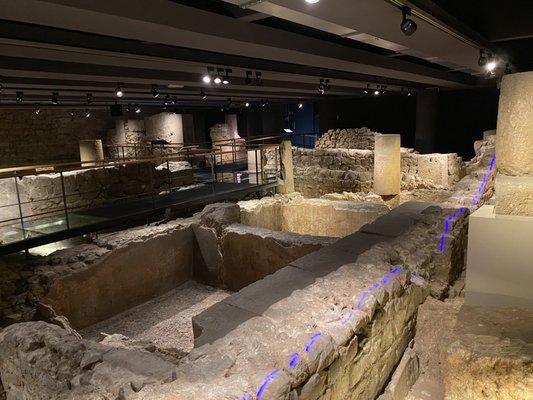
A very interesting visit for anyone interested in the history of Barcelona or archeology. Buried under modern-day Barcelona is the original Roman city of Barcino. The remains date back to the 1st century BC. A series of elevated walkways allow you to walk around and over the ruins, learning about the history and function of the facilities. It seemed parts were closed for COVID, and we weren't always very clear of the recommended path to take through the museum.
google avatar

Philip M.

Yelp
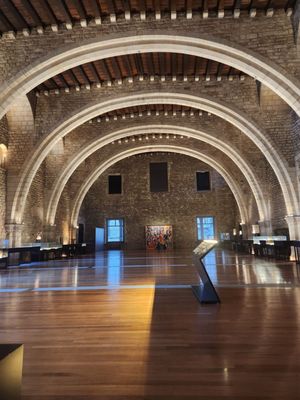
As an amateur world historian , I appreciate this display as none before. The depiction of human habitation from 5000 BC and then the layer upon layer of history through the ages is unsurpassed. Previously, Pompeii was the world standard for me . This depicts history in a different, probably more typical, way for a metro area. For anyone interested in western civilization, this should be on the list of sights to take in on a visit to Barcelona. The audio guide was especially effective.
google avatar

Isabella B.

Yelp
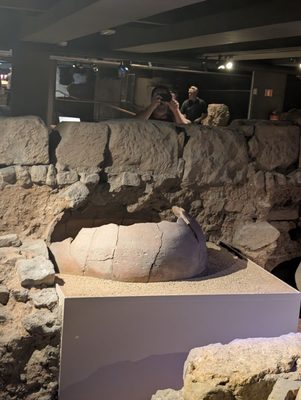
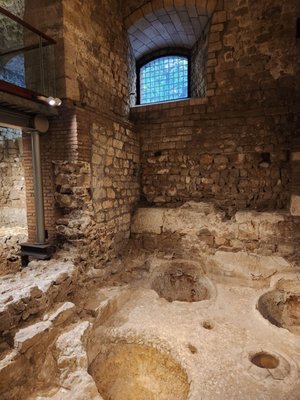
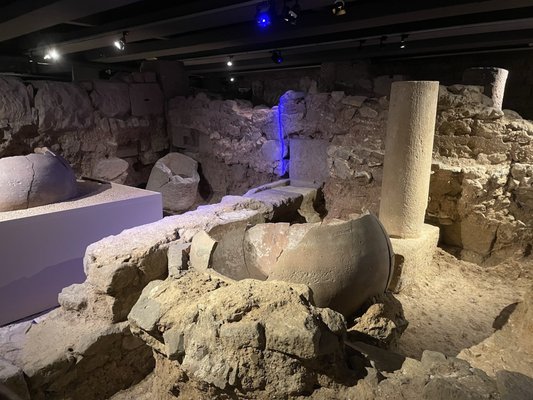
Around the time of the Roman Empire there was a colony established in the northeastern Iberian peninsula. Its full name was the Colonia Iulia Augusta Faventia Paterna Barcino, or Barcino for short. Founded by Emperor Augustus, the colonia was founded as a means of distributing land amongst retired soldiers with an incentive to guard its conquered territories as there was no standing army. Its importance as a city was significantly less so as the main city of that region was then Tarraco. Fast forward many centuries later, when the construction of the Via Laietana (a major street parallel to Las Ramblas) precluded the moving of Casa Padellàs from its previous location in Mercaders to its current location in Plaça del Rei, which once housed the rulers of Catalonia. When some artifacts were found from the ancient city a full excavation took place. The ruins also unearthed parts of the city that developed after the Roman empire fell and Christianity became the dominant religion throughout Europe. When the Visigoths took over they realized that Barcino was more suited to them than Tarraco and took over the city, turning it into a political and religious center in its own right - Barcinona. The Museu d`Història de Barcelona (MUHBA) complex comprises of several heritage sites scattered about the city spanning across many time periods. The premier heritage site is Plaça del Rei, where €7 admission includes an audioguide and also covers admission to the non-free MUHBA sites. If you're a history buff or like Roman ruins in general the admission fee is worth it for this site alone. With all the modernista architecture taking up many of the city's top sights seeing ruins can be a good change of scenery! The year prior I visited the Roman Forum; if you go into that site without any sort of guide or prior research done beforehand you will be visibly confused at a bunch of ruins. The visit to MUHBA Plaça del Rei was much more pleasant, as the included audioguide and 10-minute introductory video at the beginning of your visit give you plenty of background information needed to understand your visit, plus the audioguide tracks and signage supplement the major sights as to give even the most history-averse person enough context to make sense of what they are looking at. Plus being situated indoors, the climate control certainly helps. Compared to the Roman Forum, I also was intrinsically more interested in the ruins themselves as the excavation site contained the following: - A fullonica and tinctoria (a site to do laundry and dye garments). - Cetaria (a site to salt fish and produce fish-based sauces, with the most important being garum, which was highly prized) - Winemaking facilities More remains from Barcino when the Roman empire fell and Christianity took over such as a baptismal font, bishop's palace and early church. A lot of the church remains are underneath the modern Barcelona Cathedral The structure of the ruins themselves are so well-organized that as you walk through them you can literally see the evolution of the city throughout history. I was pleasantly surprised by my visit as this was my first visit to Roman ruins that I was able to understand the context of the ruins in relation to the history during my visit as opposed to doing more research after-the-fact. By visiting MUHBA Plaça del Rei you get another perspective of the city that predates Gaudí and his works. Being able to see multiple different historical perspectives of the city in one visit is one reason why Barcelona is considered one of my most favorite cities in Europe.
google avatar

Michael S.

Yelp
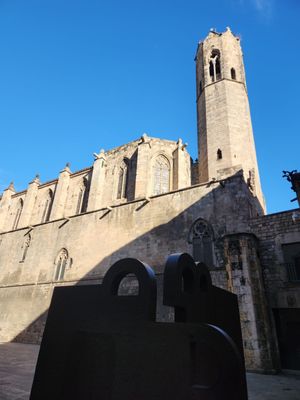
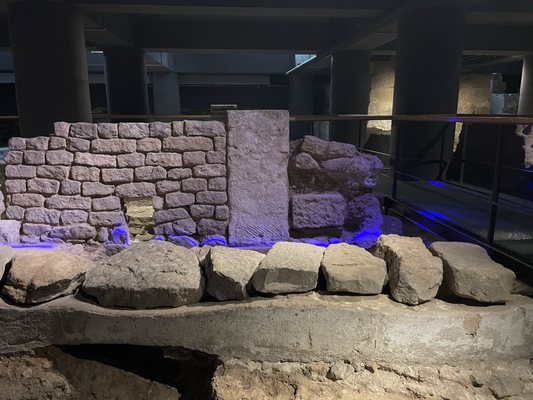
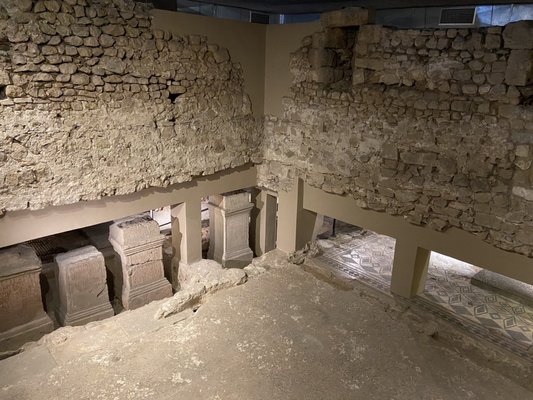
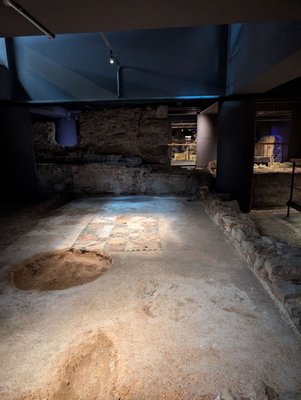
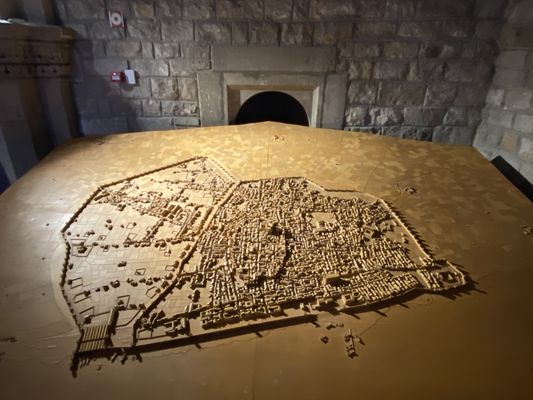
The Museu d'Història de Barcelona (aka MUHBA or the Barcelona City History Museum) is less of a museum and more of a walking underground tour of the archaeological ruins of the ancient Roman city of Barcino. The well-lit and maintained walkways, catwalks, and bridges give hands-on, close-up access to the city ruins in the Gothic Quarter, Ciutat Vella district dating from the period of Christ through the 5th century. The Catalán gothic courtyard (called Plaça del Rei) at the entrance dates to the 15th century, but has been reconstructed. The self-guided walking tour takes visitors over shops, walls, streets, and factories including laundry, dying, salted fish and wine. An early Episcopal Christian church was built on the site with parts of the building and baptistery excavated. * Closed Mondays * Open daily at 10:00 am until 7:00 pm * Open late until 8:00 pm on Sundays * Admission: 7€ * Students/seniors: 5€ * Children under 16: free * First Sundays: Free for everyone all day * Other Sundays: Free after 3:00 pm * The audio guide is NOT available on free Sunday times * Closed Jan 1, May 1, June 24, Dec 25 * Online PDF guides are available for site info * There is an English Tour (3.50€) at 10:30 some days * Take the Metro yellow line (L4) to Jaume I station Even though the Museu d'Història de Barcelona site at Plaça del Rei will not rival many of city's most famous landmarks for awe or inspiration, it is very educational and eye-opening to consider the city origins while seeing the real ruins of the ancient Roman city of Barcino.
google avatar

Kasha T.

Yelp
Literally one of the highlights of my trip to Barcelona; the ancient Roman ruins and artifacts were awesome and left this Roman history nut wishing for more time in the labyrinth of the bottom floor (unfortunately, the fam follows a strict schedule). Definitely check it out while in the Gothic quarter. All of the texts and exhibits are super informative which was a plus
google avatar

Chris L.

Yelp
It's really nice museum. Normally, I would not go this type of place when visiting. We got a good heads up from our running bean tour guide that it was free Sunday nights so we came here after our tour. The highlight is the underground Roman ruin.
google avatar

David J.

Yelp
Situated in a series of buildings that made up the old Catalan Royal Palace, the title makes this museum sound rather boring, but in fact it's a real discovery: the main part of the museum is actually a series of labyrinths, deep beneath the existing buildings and streets, showing the results of excavations covering the Roman period through to the 9th-century Visigothic era. There is a small selection of high-quality artifacts on display at various points, but the labyrinths steal the show. Roman laundries, workshops, wineries, early churches, a bishop's palace and roads are all explored via a series of elevated walkways. Displays are in Spanish and Catalan, with some English, but a comprehensive audio guided tour is included in the price, in a wide number of languages. If I have a criticism, it's that despite all the effort that has clearly been made, the interpretation is often still rather confusing, especially for such large and complex three-dimensional sites. It's also a very long walk underground, so children may begin to get a bit bored and elderly people tired (there are some seats to rest along the way, but not that many). The tour finishes with the chance to visit the impressive chapel of St Agata and the 14th-Century Hall of the Royal Palace, known as the Salo de Tinell. Here the inquisition met, and the steps leading to the Placa del Rei are where Ferdinand and Isabella stood to receive Columbus on his return from the Americas. Unfortunately, both the last rooms, impressive though they undoubtedly are, are devoid of the furnishings and interpretation that might bring them to life. But the Placa itself, where you exit, is a wonderful space.
google avatar

Ahlennah B.

Yelp
A fascinating walk thru ancient Roman ruins excavated below the surface of current-day Barcelona! You take an elevator down (back?) below street level to walk the streets of the old city. Free audioguide tells you all about the buildings you're looking at, what people used them for and when they were built. There is also signage everywhere. As a bonus, your paid ticket also gets you into about 20 other similar history museums around town. These are free entries, just show the ticket you've already bought, and the icing on the cake.. your ticket is good for ONE FULL YEAR, so you have plenty of time to come back another day for further exploration at these other sites.
google avatar

Frank T.

Yelp
Once I found out about the extensive history of the Roman empire in Barcelona, i decided to check out this museum. Entrance fee was only 7 Euro and there was no line. Included in the fee were headphones available in several languages. I recommend using them since to assist you in explaining what you are viewing. At first it appears to be a small museum with a few artifacts but once you find the elevator to the lower level you finally see what this is all about. There are extensive Roman ruins that have been preserved and studied. It's a fairly large area complete with a clear walking path and glass floor bridges. Some of the features include a wine making facility, a garum factory, laundry rooms, residences, mosaic floors and churches. This is where the headphones come in handy and help explain in detail each viewing area. If you enjoy Roman history or looking for a break from the crowds and heat, this is a great place to visit.
google avatar

Lili K.

Yelp
This museum was unique in the sense that you got to go downstairs and see all the old structures and walk around a series of excavations. I really liked that part of the museum!!!!!! FYI, this place is free on Sundays after 3pm, and it wasn't crowded at all. You also pay 1 euro to put your things away in a locker, but you get it back after.
google avatar

Melanie G.

Yelp
I was so surprised that entrance was free for this museum (looking around it appears we were there during some window when it's usually free). Either way it was a pleasant surprise because we would have gladly paid a hefty admission for this museum. When we first entered I thought it was a little meh, but then we took the elevator down, which "transported" us back in time. The ruins down there are just incredible. It really gave an idea of what life was like in Barcelona many years before. Only some of the placards explaining the exhibit are in English, but all are in Catalan and Spanish (as it should be!) I'm also a spoiled American with air conditioner, and while there was none, this museum was cooler than others because of being partially underground.
google avatar

Lucy L.

Yelp
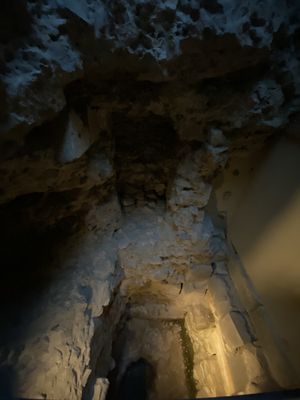
What a hidden gem! I had an hour before my time slot at the Picasso Museum and this place caught my attention. Little did I know what it housed. It was an amazing experience getting transported back on time to 1 century BC onward to witness the birth of Barcelona by walking through the ruins of Roman Barcino. The audio guide came with the ticket, which was €7. Pick one up and it'll tell you stories of this ancient city. I couldn't be happier to stumble upon this less visited spot.
google avatar

Ann Marie C.

Yelp
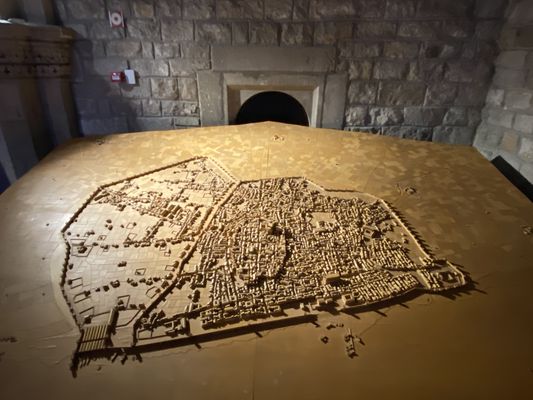
You've seen Sagrada Familia, Camp Nou, Parc Guell, the beach and you've wandered through the Old City hung over from clubbing, but you haven't seen Barcelona until you get to see the old Roman city. Above ground there is a little, well-done exhibit with a movie presentation where one can see the physical evolution of the land and city. It's quite interesting to see how much of the city is built onto the Mediterranean. The movie presentation alternates showings in Catalan, English and Castellaño. (I was pretty proud of myself in muddling through the Spanish version and coming out understanding it.) The main show lies underneath you, though. I believe this is a relatively new find, but there is a lot to see and the scale on the walls showing the lower you go the older things get is pretty dang cool. The first hour imagining cramped living quarters and tiny, industrious work spaces made me feel better about my own shoe-box apartment. However after that my creative juices ran out and it all started to look the same, little piles of Roman rubble. *NOTE* This museum is free to everyone every Sunday after 3. Plan accordingly.
google avatar

Bori A.

Yelp
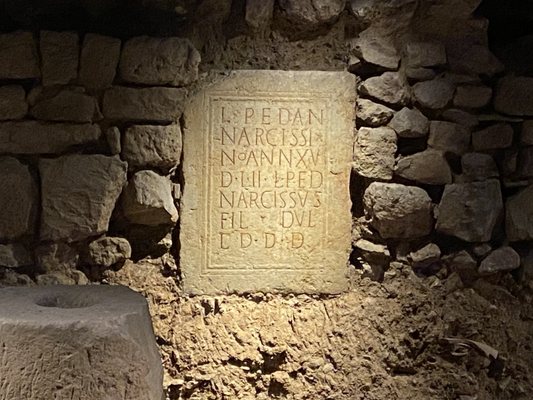
A very detailed and extensive exhibition, recommended for all history fanatics. It presents the history of the location that is now Barcelona, starting from prehistoric ages and ending with medieval times. The main exhibition starts below ground, with an elevator showing you how long you went back in time instead of the distanceon its display, as it is carrying you to the right place (or time?): the excavation of houses and other buildings from the Roman ages. The audio guide tells you a lot of interesting stories about the day to day life of people living in Barcino, the settlement at this location at the time. As you slowly progress back to the surface, you also get to travel closer to the present in time, which is a really interesting idea.
google avatar

Shannon A.

Yelp
Sooooo stoked to kinda stumble upon free Sunday afternoon entry (after 3 pm) and be able to step back in time -- really cool to be reminded firsthand of Barcelona's deep history and slip underground into some serious culture! It is right behind the Cathedral so it is extremely easy to double-dip with two major Barcelona hotspots steps away from each other, but it's is somewhat of a hidden gem -- don't miss it :)
google avatar

JoJo T.

Yelp
This place totally gets the award for #1 worst museum ever. The most exciting thing we saw was a pile of rocks. It is a huge mistake to even think about going here especially with kids. My children were so bored and I even didn't see anything cool or interesting about this place. If you want to go to a museum, go to anywhere but here.
google avatar

Michael C.

Yelp
Are you an ancient history buff? Enjoy a good Roman tale of conquest? Then this museum is the right one for you. The majority is actually located several feet below ground. It's is amazing to think that all these ruins, or what's left of them, lie beneath the city. I did the audio tour selectively, there is just too much content for the amount of time I wanted to spend here. This is a good thing. Another must stop spot on your museum tour.
google avatar

Jaison S.

Yelp
There's a lot to see at this museum about ancient Barcelona. I visited on 8/12/11 and paid 5euro to get in (i think this is the student rate). The tour starts off with a look into early Roman colonization and development of Barcelona. There's an educational video shown in a room off to the side. You'll also find ancient tools, scripts, and maps. On the next floor you have the "archaeological subsoil". Here you take a look into how people of Roman Barcelona lived. There are several artifacts on display and an entire room of actual preserved facilities from that era. Coolest thing I remember was a model of noble person's house. The last two sections are a look into Barcelona during the middle ages. These parts of the museum were actually part of the Royal Palace at one point. -- As you exit the museum, the steps you go down when walking outside are the steps where the King greeted Christopher Columbus when he returned from his "trip". Audioguide available.
google avatar

Qype User (.

Yelp
Great Museum, which is not yet found in many guidebooks. You can discover the roman past of the city directly on site and then wander through the centuries and see how the site has evolved. Fantastic mix of archeological reality and animated exhibits.
google avatar

Tamara N.

Yelp
So lovely. So much history about Catholics and baptist. I'm so glad I got to see this place.
google avatar

Mikael S.

Yelp
I've been wanting to visit this place since I first was in Barcelona in 1989. Sadly it took a long time although I've visited Barcelona on a regular basis since 2008. The museum is very well structured and you walk through different time periods. There is also a short film you can watch about the history of Barcelona and the surrounding area, the film is a little dated but it's ok. When you enter the lower level you enter the old Roman province Barcino. The excavation of the ancient city is extensive and you get a clear sense of how the city must have felt and looked like. We were there for 3,5 hours at least so plan your visit, there's a lot to be seen in this museum.

Sarah C.

Yelp
This was a great museum to visit-- loved the elevator that transports you from 2017 to 12BC! The downstairs exhibit that showcases the ancient ruins from early Roman Empire days is impressive! We went on a Sunday and admission was free. Highly recommend visiting!
google avatar

Marielle S.

Yelp
MUHBA: Placa del Rei is often overshadowed by Barcelona's more visible attractions but it is NOT TO BE MISSED. The tour-able roman ruins neath the square's foundation make this the no. 1 most interesting museum in the city--imo of course. The attraction's hidden gem status keeps the lines short, the tickets affordable, and the crowds at bay. Free on Sundays after 3pm!!!

J R.

Yelp
Walk back into time 2000 years in this underground museum. The ancient Roman ruins beneath Barcelona is truly spectacular. Go early and be by yourself.
google avatar

V V.

Yelp
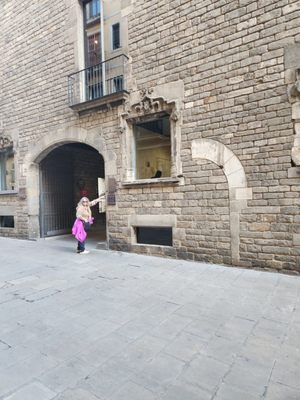
This took forever to find for some reason, the entrance is kinda hidden. Very cool history about the city. Free on sunday after 3pm but they dont offer the audio tour at that time.

Ben S.

Yelp
Absolutely awesome experience, a great way to go back in time. A city under the city opens up and it is all so accessible and easy to imagine. From the Daily life of 1st century Barcelonians to the the different periods of this great city - it's all right there... I think. Because as it turns out this great museum doesn't think English is a major language and therefore a lot of the displays leave you the English speaker guessing. There is an audio tour device available but since we were (un)fortunate enough to get there during the Sunday afternoon free admission window (cool) these devices were not made available to visitors, not even if you were willing to pay... So no devices, not enough English signage, but still a highly recommend experience that will worth your time...