Rahul P.
Google
Rethinking the Social Contract
A visit to Social Cyberhub reveals that the line between clever concept and actual substance can be as wobbly as their intentionally misspelled menu.
There's something distinctly millennial—or is it Gen Z now?—about walking into a restaurant that's trying quite this hard to be casual. The menu at Social Cyberhub arrives festooned with deliberately haphazard capitalisation, a typographic rebellion that screams "we're not like other restaurants" while simultaneously ensuring you need to squint a bit harder to order your dahi bhalla.
The manifesto is revealing in its desperation to be everything to everyone: Punjab to Kerala, Irani café to toddy shop, almond milk latte to khari biscuit dunking. It's the culinary equivalent of a dating app profile that lists both hiking and Netflix as interests—technically accurate, ultimately meaningless.
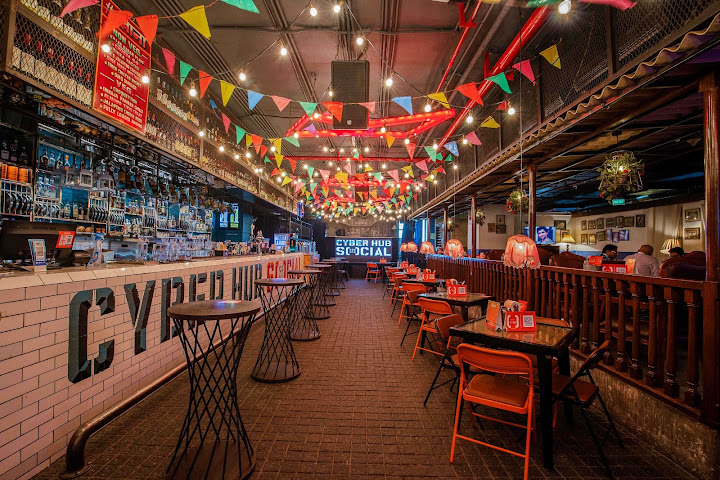
Riyaaz Amlani's Impresario Handmade Restaurants has built its empire on concepts, and Social is perhaps the most aggressive example of this approach. The idea—a Mumbai chawl reimagined as a dining space—is clever enough. And to be fair, they've committed to it: five chawls and a conference room, tenant boards in Hindi, electric meters trailing wires like nostalgic cobwebs, deliberately mismatched flooring that's been carefully designed not to trip you.
But here's the thing about concepts: eventually, you have to eat the food.
When It Works
Credit where it's due—the Dimaag Ka Dahi Bhalla justifies its cerebral pretensions. This is bhalla done properly: proper chill to the dahi, the saunth-mint interplay working exactly as it should, pomegranate providing those little bursts of sweet-tart that elevate the whole affair. No overthinking, just good execution of something familiar.
The charred veg spring roll managed that difficult trick of being neither too virtuous nor too indulgent. Proper char, proper crunch, none of that limp sadness that plagues so many vegetarian "options."
The China Box—with its slightly infantile name—is actually rather good if you make the right choices. Hot garlic sauce with hakka noodles and paneer, properly stir-fried, delivers exactly what it promises. It's comfort food that doesn't apologise for being comfort food, and there's something refreshing about that in an era of deconstructed everything.
Even the Rita Sangria, which could easily have been another cynical fusion gimmick, worked. Sometimes you just want something cold and fruity with a bit of kick, and this delivered without trying to reinvent the wheel.
When It Doesn't
But then there are the Khao Suey Momos—a dish that exists purely because someone in a brainstorming session said "what if we combined two things?" and nobody asked "but should we?" The plant-based version is particularly joyless, proof that not every ingredient substitution is a good idea, and not every fusion makes sense beyond the whiteboard.
The Dum Pukht Mutton Biryani suffered from that peculiar disease that afflicts so many modern restaurants: the assumption that heritage cooking can be approximated through technique alone. Dum pukht is a method that demands patience and precision; here it felt like a name more than a process.
And the Classic Picante—well, let's just say "classic" is doing some heavy lifting in that name.
The Verdict
Should you go? If you're in Cyberhub and hungry, certainly. Order the dahi bhalla, the China Box, skip the fusion experiments, and don't think too hard about the semiotics of it all.
The old social spaces of India that Social claims to celebrate were born of necessity, community, and genuine human need for connection. This is born of market research, focus groups, and the need to generate returns for investors.
Both are valid. But let's not pretend they're the same thing.