Ruben B.
Google
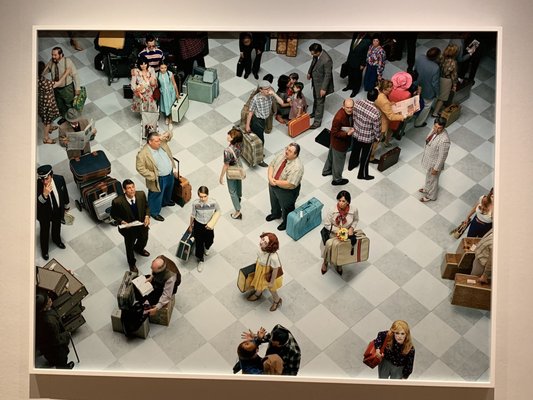
As I moved through the rooms of FOAM, I felt suspended between histories, ideas, and emotions — fitting for Blommers & Schumm’s Mid-Air, a title that seems to describe the entire experience. The exhibition plays with the boundaries of perception: photographs so meticulously composed — two pencils, two plastic cups bridged by a ruler, the smooth fall of hair becoming architecture — that they seem to hover between order and absurdity. Beneath their surface perfection, I sensed questions about balance, identity, and the longing for control in an uncertain world.
That sense of suspension deepened when I entered Augusta Curiel’s Yere Mi Sten. Her early 20th-century images of Suriname touched me in a way that felt both intimate and uneasy. With my own Surinamese roots, I couldn’t help but read them through personal memory. What struck me immediately was how light-skinned most of the people in her photographs were — a visual reminder of colorism, the inherited hierarchy that privileges lighter skin and proximity to whiteness within postcolonial societies. It’s not just history; it’s something still present in Suriname today, shaping how people are seen and valued. Curiel’s portraits, whether intentionally or not, reveal that social stratification. Yet her gaze remains empathetic, dignified — she made the invisible visible, even within the limits of her time.
And then came Co Rentmeester’s Jumpman — a jolt of energy and defiance. Seeing his photograph of a young Michael Jordan soaring across the page of LIFE magazine, alongside his battered Nikon camera enclosed in glass, hit me hard. This wasn’t just an image; it was a statement about authorship and justice. I found it deeply inspiring that Rentmeester, a Dutchman, had the courage to take on Nike in court — not for fame, but for fairness. He fought to assert that creative work has value, that images are not merely commodities but acts of intellect and vision.
Nearby, a haunting photo showed him after being shot while documenting the Vietnam War — a reminder that his commitment to truth literally risked his life. Together, those two moments — the triumph of Jumpman and the vulnerability of a wounded reporter — reveal a man who saw the world with both precision and courage. His scarred camera, wrapped in tape and still capable of seeing, felt like a perfect symbol of resilience: art as endurance.
By the time I circled back to Khashayar Javanmardi’s The Caspian, the exhibition felt like a continuum of breath. His video, steeped in Persian myth and digital memory, spoke of rebirth and transformation — of how cultures, like images, never die but constantly evolve.
Leaving FOAM, I felt gratitude for what these artists had in common: the courage to look. Curiel, Rentmeester, Blommers & Schumm, Javanmardi — each in their own way wrestles with visibility, truth, and the weight of representation. Together they form a conversation across centuries and continents about who gets to be seen and on whose terms.
Photography, I realized, doesn’t simply capture; it confronts. It asks us to look again — not weightlessly, but with awareness. And perhaps that’s what Mid-Air really means: learning to see the world in suspension, between beauty and justice, between light and its shadow.