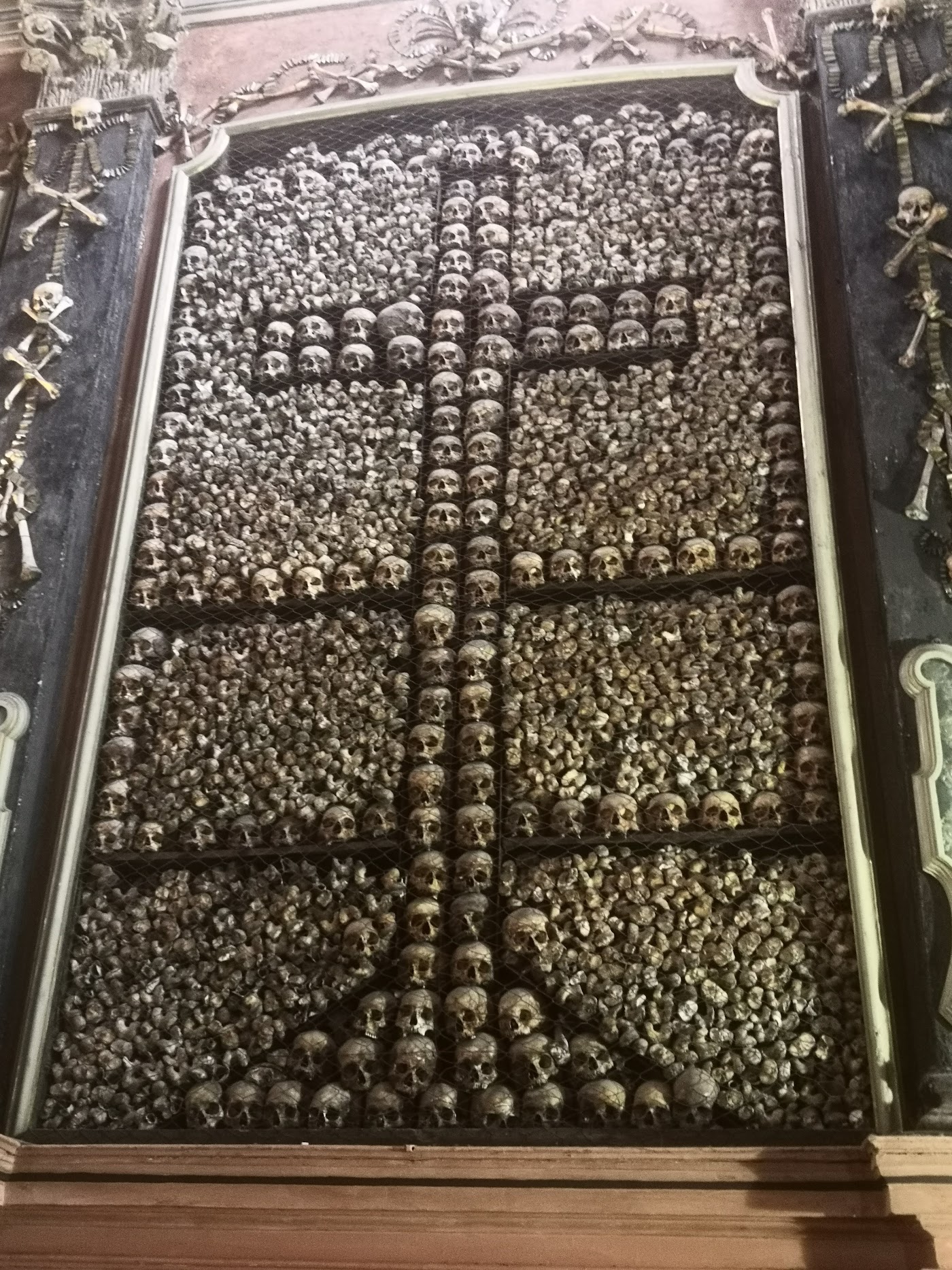
Santuario di San Bernardino alle Ossa
Shrine · Quarto Oggiaro ·

Santuario di San Bernardino alle Ossa

Shrine · Quarto Oggiaro ·

Church featuring an ossuary decorated with human skulls and bones

Information

Piazza Santo Stefano, 20122 Milano MI, Italy Get directions

Information

Static Map

Piazza Santo Stefano, 20122 Milano MI, Italy Get directions

+39 02 781724
sanbernardinoalleossa.it

Features

wheelchair accessible entrance

Last updated

Dec 10, 2025

Powered By

You might also like

Terms of Use • Privacy Policy • Cookie Policy
 © 2025 Postcard Technologies, Inc.
@itstherealjeff
261 Postcards · 23 Cities

In honor of all the victims of the plague, who couldn't be accommodated by the cemetery. Once inside, turn right and walk through a hallway until you reach the ossuary. The chapel is dark and rather small, and every inch of the walls is covered with human bones and skulls piled behind a wire mesh.

Milan 2024
Santuario di San Bernardino alle Ossa

Murat K.

Google
Hidden just minutes from the Duomo, San Bernardino alle Ossa is a unique and haunting chapel. First built in 1210 near a hospital, the ossuary was created due to lack of burial space. Rebuilt in 1712 after a fire by Carlo Giuseppe Merlo, it features walls decorated with human bones and a striking 1695 fresco by Sebastiano Ricci. Small but powerful, it offers a rare reflection on life and mortality. A must-see in Milan. Note: Sundays is closed and you cannot visit the oyster.

Timothy P.

Google
Impressive place, interesting for the Catholic iconography and attractive architecture. Always interesting to see the difference between Catholic churches and Protestant places. Domed roof rather attractive. Free to enter and look around. Quiet inside. Good place to sit. Steady stream of tourists but not too busy generally.

Percy C.

Google
It is close to the Duomo. The ossuary is not big, but fascinating. The ceiling is nicely painted. The walls are decorated with human bones and skulls. The atmosphere is not crowded.

Mark L.

Google
Wow, what an interesting experience. The Church of the ones is a must see when visiting Milan. About 10 minutes walk from the Duomo but well worth it!

James L.

Google
As with every church I stumbled on in Milan, the inside was absolutely breathtaking. So many intricate details and beautiful art adorning the walls and ceiling. A nice, lighter breath of fresh air compared to the other sanctuary room a few steps away… But you cannot miss the other room! It’s macabre and fascinating all at once. The sheer number of bones on the walls was enough to make me shudder. A fascinating experience.

Alessandro De S.

Google
Must-visit church in Milan. Very eerie and mysterious atmosphere, with walls full of skulls and bones. You’re allowed to take pictures inside—just make sure to avoid using flash.

Monika

Google
A hidden gem that many tourists don’t know about — a beautiful ossuary just five minutes from the Duomo Square. Definitely worth a visit. Free entry

Julia S.

Google
In the historical center of Milan, not far from the crowded Duomo square, in the shadow of the parish church of Santo Stefano (famous for the fact that Caravaggio was baptized there), there is a very dark and mysterious place - the ossuary at the church of San Bernardino alle Ossa. The building we see now was built in 1750 according to the design of the architects Andrea Biffi and Carlo Giuseppe Merlo in the Baroque and Rococo style. It belonged to the Brotherhood of the Flagellants, whose monks created the ossuary. A mystical place, surrounded by many legends and stories. The bones were left behind when the old cemetery of the Brolo hospital was demolished when it was closed in 1652. The monks of the Flagellant Order collected the bones of those who died in the hospital, as well as the bones of the monks and canons of St. Stephen, and decorated the walls of the chapel in the most macabre way possible. If the goal was to impress, the monks certainly succeeded. The chapel was so revered that one of its visitors was John V, King of Portugal, when he was in Milan. He was so impressed by the ossuary that he ordered a similar one to be built in the city of Evora, near Lisbon: the Chapel dos Ossos. In the following years, the influx of pilgrims increased so much that the small church next to the chapel had to be expanded, creating the current building of San Bernardino.