Tim Y.
Yelp
I've been to Miraikan twice, the second time being April 17, 2017.
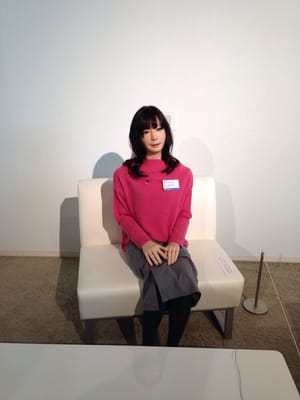
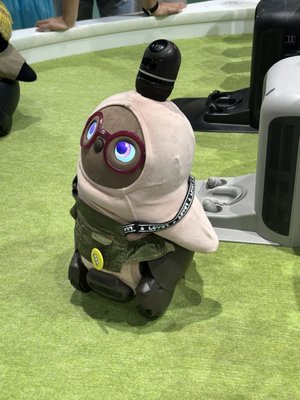
There are some interesting things at Miraikan that are pretty straightforward, like the look inside the International Space Station, or Asimo. Obviously many people are interested in the robotic stuff, and that's interesting enough. But I feel that many of the exhibits are struggling to convey rather complicated ideas, and fall back on simply trying to explain things in words.
I was surprised at the amount of writing that is presented in the museum exhibits. At times I felt as if someone had handed me a textbook. Or I would go to a screen (such as in "Songs of Anagura") and only get a professor talking to me, as if I were in a classroom. This is exactly the opposite of what a science museum should be! The whole point is to SHOW us things in a way that we can't get from a textbook or a lecture.
My reaction after leaving many of the exhibits was often either "that wasn't quite as interesting as I expected" or "I didn't quite understand that." I think the museum's idea of giving us things to think about is not a bad one, but there really needs to be some amazing information communicated to us as well.
I think "Backward from the Future" was the exhibit where I most sensed a struggle to communicate the intended message.
First of all, we choose which type of future we would like to aim for, and we stamp our choice onto the paper provided. But then this paper is never needed again.
We're asked to think backward from the future in planning our course, but we're given no idea of HOW to do such planning, and it's not clear what difference it would make if we did. Plotting our course through the future feels very random; we have no criteria or tools for doing so.
I suspect that most kids launch their icon toward the future and then walk away. I did follow mine over the hill in the exhibit and saw that, after it crashed and burned, it said there was a letter for me, but I didn't know where to see this letter. My daughter pointed out that it was on the screens off to the side. (It's a letter "from" someone in the future, explaining why my choice for how to proceed through the future, "a world where everyone has enough to eat", only lasted 30 years.) More reading to do, and reading that's easily forgotten as we move on to the next exhibit. The message about a sustainable future is a worthwhile one, but I felt that it wasn't communicated clearly. Also, it was rather unsettling that none of the potential futures seemed to be all that sustainable!
(This exhibit might have been better if the letter from the future were somehow PRINTED onto the paper that we stamp at the beginning. Then there would be no mystery about where the letter was, and more people could read and remember their letters, since they could take them home.)
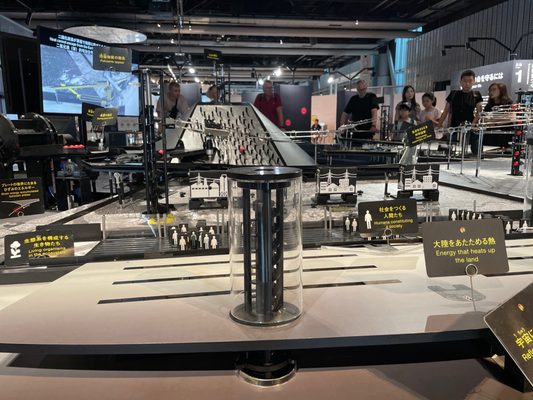
This brings me to another point: most museum-goers are simply going to scan all the reading briefly, because we don't want to stand there a long time and read. So we don't remember what we read and so a lot of effort is made to communicate things that we won't clearly remember. The museum needs more teaching that is VISUAL, rather than written or spoken. There is some (although sometimes the visual teaching doesn't communicate clearly -- I struggled to understand what all the rolling balls in the science workshop represented -- "energy"?), but there needs to be more.
I mentioned "Songs of Anagura." This is an exhibit in which you are followed around a room by a projection on the floor, called your "me", which represents your personal data. The room feels a bit like a disco, with "vocaloid" music playing, and projections on the walls of dancing silhouettes. You are tracked as you walk around the room visiting different stations, which talk about issues of personal privacy in the era of the Internet and GPS. After you have walked around the room enough, the exhibit tells you that it will generate a song from your data. But it wasn't clear to me HOW it generated this song, which sounded pretty much like the others that had played before. It's an interesting idea, but again, execution could have been better.
Anyway, I would say that Miraikan is good, but not great. I hope they will be able to make some effort toward making the museum more visual and interactive, and less like a classroom.