Qype User (.
Yelp
An unusual museum in many ways reminiscent of Victorian style.
Whitby Museum is an independent Museum founded in 1823 and run by Whitby Literary & Philosophical Society. The main hall retains the atmosphere of a Victorian/Edwardian Museum and has sometimes been called a 'Museum within a Museum'. It is also remarkable for the variety of its collections.
An amazing collection of local fossils, natural history, model ships, carved jet, toys, costumes and social history. There are relics of the Scoresbys - famous whalers - and Captain Cook. Ships captains of the past brought back to the Museum unusual things from all the seven seas.
The fossil collection with the wall mounted saurians and the wonderful jet collection are of international importance. Other very important collections are the Samplers, Ethnography, Ship Models and the Scoresby (2 whaling captains). If you are interested in natural history, James Cook, archaeology, ceramics, paintings, bygones, Whitby Abbey, toys and dolls or militaria you are bound to find something of interest. A large varied and ever growing collection of toys, dolls, books and games ranging from Elizabethan wooden dolls to the Pelham puppets along with an early Punch and Judy set.
A host of other toys includes a furnished dolls house plus a selection of tin toys and wind up vehicles.
There is also a varied selection of wax-headed, bisque and composition dolls, most in beautiful costumes.
The really interesting part ..a MUST SEE!
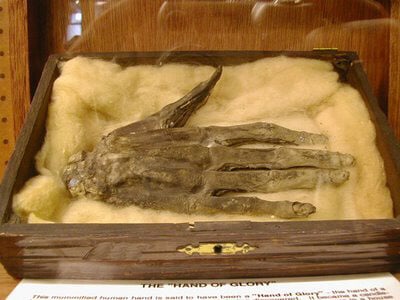
Whitby Museum is the home of the 'Hand of Glory' (used in many a novel)
The Hand of Glory is the dried and pickled hand of a man who has been hanged, often specified as being the left (Latin: sinister) hand, or else, if the man were hanged for murder, the hand that did the deed.
According to old European beliefs, a candle made of the fat from a malefactor who died on the gallows, virgin wax, and Lapland sesame oil (the candle could only be put out with milk), and the hand having come from the said hanged criminal, lighted and placed in the Hand of Glory (as in a candlestick) would have rendered motionless all persons to whom it was presented. (In another version the hair of the dead man is used as a wick, also the candle is said to give light only to the holder.) The Hand of Glory also purportedly had the power to unlock any door it came across.
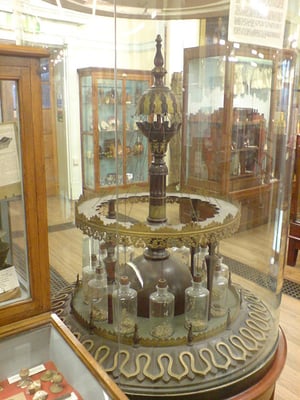
The other wonderful item is the 'Tempest Prognosticator'.a 19th century invention by George Merryweather in which leeches are used in a barometer. The twelve leeches are kept in small bottles inside the device; when they become agitated by an approaching storm they attempt to climb out of the bottles and trigger a small hammer which strikes a bell. The likelihood of a storm is indicated by the number of times the bell is struck.
The Society also runs a library, an archives and lectures. A new wing has been recently added to the Museum and contains temporary exhibitions and costume galleries as well as displays on ship building, herbaria and the Growth of Whitby.
The Library and Archives:
Contains books and other resources on the history of the Whitby area. Members of the public are welcome Tuesdays to Fridays 10am to 1pm and the first Sunday afternoon of each month 2pm-4pm.
Prices
Adult £3.00
Child £1.00
Family £7.00
Concession £2.50