Archaeological site of Mycenae
Archaeological site · Peloponnese ·

Archaeological site of Mycenae

Archaeological site · Peloponnese ·

Ancient citadel with beehive tombs and Lion Gate ruins

history
treasury of atreus
royal tombs
monumental architecture
mycenaean culture
historical place
ancient civilization
ancient and mysterious atmosphere
Archaeological site of Mycenae by null
Archaeological site of Mycenae by jeanatos (Atlas Obscura User)
Archaeological site of Mycenae by Alice Sharpless
Archaeological site of Mycenae by Xuan Che on Flickr (Creative Commons)
Archaeological site of Mycenae by Harvey Barrison on Flickr (Creative Commons)
Archaeological site of Mycenae by Andrew Baldwin on Flickr (Creative Commons)
Archaeological site of Mycenae by History Fangirl (Atlas Obscura User)
Archaeological site of Mycenae by Jaysmark on Flickr (Creative Commons)
Archaeological site of Mycenae by null

Information

Mykines 212 00, Greece Get directions

Information

Static Map

Mykines 212 00, Greece Get directions

+30 2751 076585
odysseus.culture.gr

Features

Last updated

Jan 28, 2026

Powered By

You might also like

Terms of Use • Privacy Policy • Cookie Policy
 © 2026 Postcard Technologies, Inc.
@atlasobscura
4,908 Postcards · 2,018 Cities

History Tour: The Bronze Age World

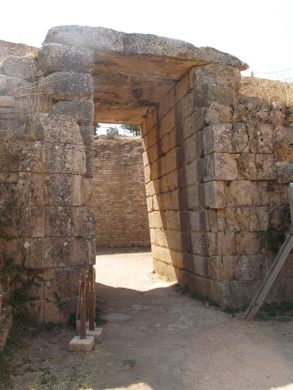
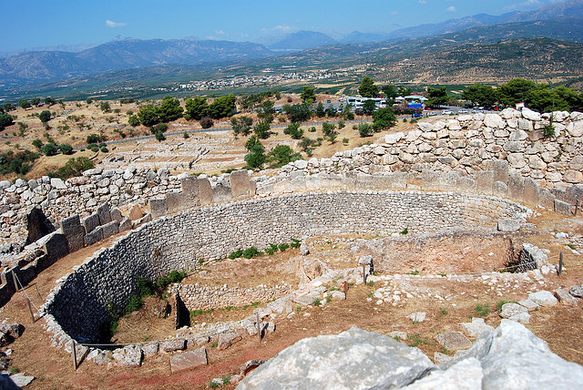
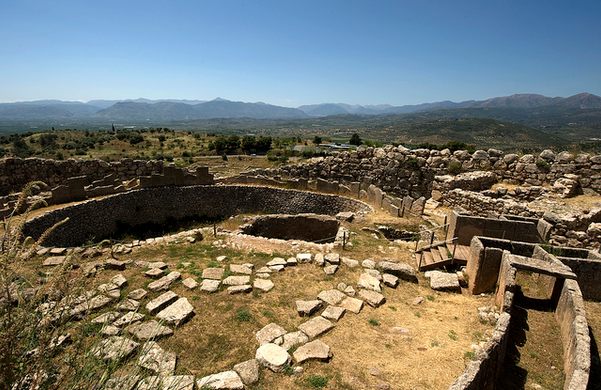
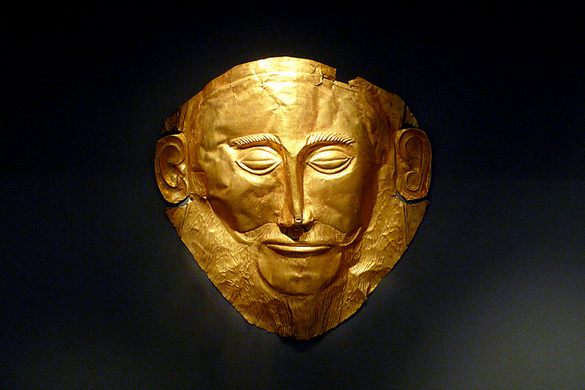
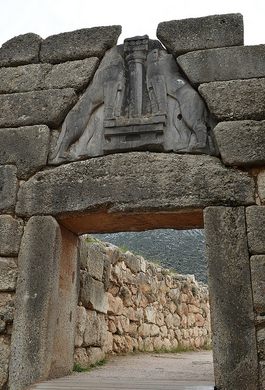
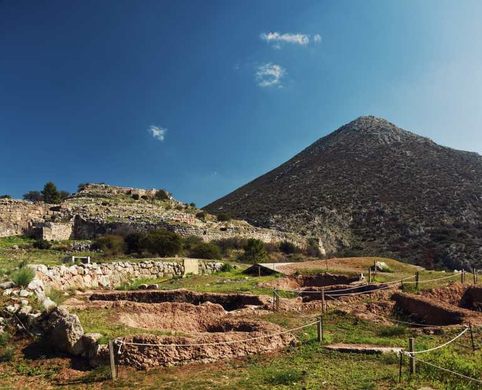
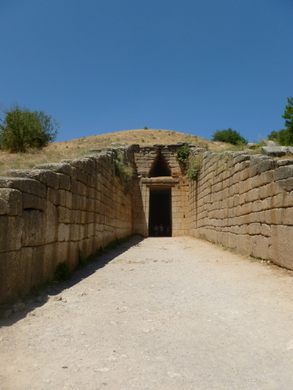
"On a hilltop among hilltops on the Peloponnesian peninsula in Greece, an ancient stillness pervades the poppy-strewn countryside and muffles the bells of nearby sheep with their shepherds. And yet the tour buses continuously rumble up to the ancient stone remnants of a great city. Stone lions gaze upward even as round tombs huddle deeper into the earth. This is Mycenae, once the major power in the Bronze Age and Helladic Greece, controlling most of southern Greece and communicating with other trading centers as far away as Crete and Egypt, but no more than a tourist attraction since Roman times. This is the home of larger than life literary and mythological figures, from the hero Perseus to the bloody dynasty of the house of Atreus. Mycenae was also the kingdom of Agamemnon, who pursued his brother’s wayward bride (and the riches she hid among) to the far shores of Troy. Ill winds at the outset of the Greek army’s journey persuaded the king to sacrifice his own daughter to gain godly favor and precipitated an equally bloody chain of events upon his return home 10 years later. His vengeful wife Clytemnestra and her lover killed Agamemnon in the bath, the writer Aeschylus says in his Oresteia trilogy, which in turn led Agamemnon and Clytemnestra’s son Orestes to seek revenge for his father.  When amateur archaeologist Heinrich Schliemann, fresh from his excavations at Troy, came to Mycenae in 1874, he began a large, systematic excavation and maintained his zeal for finding evidence of his beloved Homeric epics. Excavations uncovered a plethora of shaft graves, many of which contained a wealth of grave goods, including weapons, jewels, and beaten gold death masks. Despite the date of these tombs being quite a bit earlier than the layer of Troy he believed to be in contact with the Mycenaeans, Schliemann famously said upon finding the golden mask of a particularly serious bearded man, “I have gazed upon the face of Agamemnon.” The mask has retained this moniker and is on view at the National Archaeological Museum in Athens, along with other finds from the site.  Perhaps the most famous feature of the site is the set of beehive tombs (tholoi). The tholoi marked a transition in burial practices from the earlier shaft graves and, while their grand nature implies the presence of important individuals, their visibility also made them easy prey for looters, and little was found within them.  Also of note are the slippery stone steps that lead down into the hillside to the long-filled-in remnants of an ancient cistern. Fed by a spring outside the city walls, the secret cistern gave the Mycenaeans access to water even if the city came under siege.  Although Schleimann harbored a romantic hope of finding his beloved Homeric heroes in the remnants of Mycenae, the wealthy residents of the shaft graves predate even the cyclopean walls of Mycenae’s citadel. However, if we allow that the characters in the works of Homer and other poets are not rooted in a concrete timeline, but are echoes of earlier figures and events that were so important that they were passed on through the ages in the collective memory of the ancient Greeks, it is easy to believe that we have gazed upon the face of Agamemnon as well." - ATLAS_OBSCURA

https://www.atlasobscura.com/lists/atlas-guide-to-bronze-age
Jaysmark on Flickr (Creative Commons)
Archaeological site of Mycenae

Magda

Google
He had a virtual guide that showed us how the sites we were walking through could look like when they were built. Such a cool thing. The site itself really nice, open. The views are amazing.

Jimus D.

Google
This archeological site is okay. Please note that the entry of 20€ for this site also includes the entrance to the treasury near by, which I recommend more than this site. You don't need to pay for it twice. This archeological area in particular is fairly big but as with a few greek sites, this one doesn't seem well conserved. It's ending up to be just stones and requires a lot of imagination for the entry price. The paths around the archeological site cross over some of the old wall structures, so you have to walk on top of the ruins. Which is a little weird as more people walk over them, more will it damage. I also spotted some asian tourists walking on top of some of the archeological ruins, areas clearly excluded and even taking some little stones from these ruins. With no security or anyone controlling this. Unfortunately, if the sites are treated this way, they won't last another century. A great thing is the nature around the site, is really beautiful.

Keith D.

Google
Visited in late November and absolutely loved it. The site is spectacular, full of atmosphere, and even more magical in the off-season — there were moments where I had entire areas to myself. It gives you the sense of walking through history without the crowds, with time to slow down and take it all in. A beautiful, haunting, and unforgettable place to explore.

Graham T.

Google
This was a truly remarkable archaeological site. Not only is it amazing and in extremely good condition comparatively, visiting in December means that there was hardly anyone there. We had the stadium and the theatre to ourselves. It’s a fascinating three hours of your life that everybody should experience. It takes only about 40 minutes to drive there from Kalamata.

Lucas L.

Google
Went when it was free, worth it. One of the nicer archaeological sites of this civilisation. Some boards available to read about. Didn't visit museum as I came close to closing. Good view from the top

Jessica&Tom W.

Google
Very interesting history and some very impressive sights. Some of the paths are slippery and hard to walk on so be mindful of what shoes you wear. Costs 20 per person so not bad but would be a much better value if you are a history buff. The experience was quite humbling at times thinking about the ancient civilization. Parking was nuts and it wasn’t even that busy of a day. Overall we were happy we went but it isn’t something we’d pay for again.

Peter E

Google
Easy slope from car park leads you to the entrance to the site through the lions gates. The walk gets a bit steeper as you ascend to the palace level, but a gentle downhill track loops around. Can be a bit slippery when wet or dusty but well worth the effort. 20 euro for combined museum & site.

Στέφανος Υ.

Google
A great monument of Greek history, just to think it was built by humans is insane, I won't say much but you should definitely both visit it and learn it's history and mythology as it is as magnificent and magical as the monument it shelf!