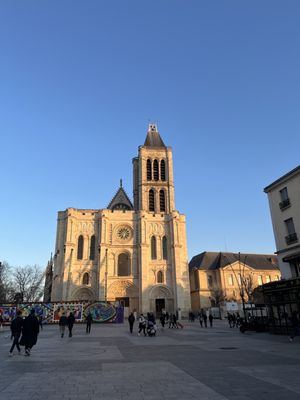
Basilique Cathédrale Saint-Denis
Basilica · Saint-Denis ·

Basilique Cathédrale Saint-Denis

Basilica · Saint-Denis ·

Birthplace of Gothic architecture and French royal necropolis

Basilique Cathédrale Saint-Denis by null
Basilique Cathédrale Saint-Denis by Allison (Atlas Obscura User)
Basilique Cathédrale Saint-Denis by Pierre-Emmanuel Malissin et Frédéric Valdes/CC BY-SA 3.0
Basilique Cathédrale Saint-Denis by Chabe01/CC BY-SA 4.0
Basilique Cathédrale Saint-Denis by Pierre-Emmanuel Malissin et Frédéric Valdes/CC BY-SA 3.0
Basilique Cathédrale Saint-Denis by Getty Images/ FRANCOIS GUILLOT
Basilique Cathédrale Saint-Denis by Pierre-Emmanuel Malissin et Frédéric Valdes/CC BY-SA 3.0
Basilique Cathédrale Saint-Denis by Allison (Atlas Obscura User) (Allison Meier)
Basilique Cathédrale Saint-Denis by Pierre-Emmanuel Malissin et Frédéric Valdes/CC BY-SA 3.0
Basilique Cathédrale Saint-Denis by Chabe01/CC BY-SA 4.0
Basilique Cathédrale Saint-Denis by Allison (Atlas Obscura User) (Allison Meier)
Basilique Cathédrale Saint-Denis by Getty Images/ FRANCOIS GUILLOT
Basilique Cathédrale Saint-Denis by Chabe01/CC BY-SA 4.0
Basilique Cathédrale Saint-Denis by Allison (Atlas Obscura User)
Basilique Cathédrale Saint-Denis by Allison (Atlas Obscura User) (Allison Meier)
Basilique Cathédrale Saint-Denis by Allison (Atlas Obscura User)
Basilique Cathédrale Saint-Denis by Getty Images/ FRANCOIS GUILLOT
Basilique Cathédrale Saint-Denis by Allison (Atlas Obscura User)
Basilique Cathédrale Saint-Denis by Pierre-Emmanuel Malissin et Frédéric Valdes/CC BY-SA 3.0
Basilique Cathédrale Saint-Denis by null

Information

1 Rue de la Légion d'Honneur, 93200 Saint-Denis, France Get directions

Information

Static Map

1 Rue de la Légion d'Honneur, 93200 Saint-Denis, France Get directions

+33 1 48 09 83 54
saint-denis-basilique.fr
@basiliquesaintdenis

Features

wheelchair accessible parking lot
wheelchair accessible entrance

Last updated

Dec 5, 2025

Powered By

You might also like

Terms of Use • Privacy Policy • Cookie Policy
 © 2025 Postcard Technologies, Inc.
@atlasobscura
4,908 Postcards · 2,018 Cities

An Unromantic Look at 10 Preserved, Disembodied Hearts

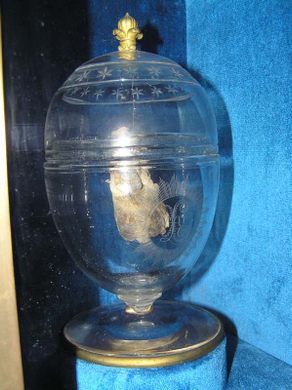
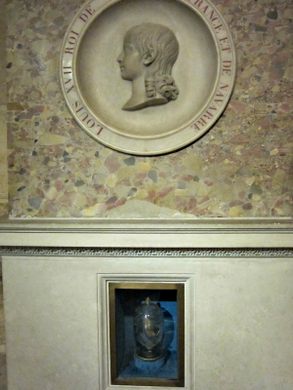
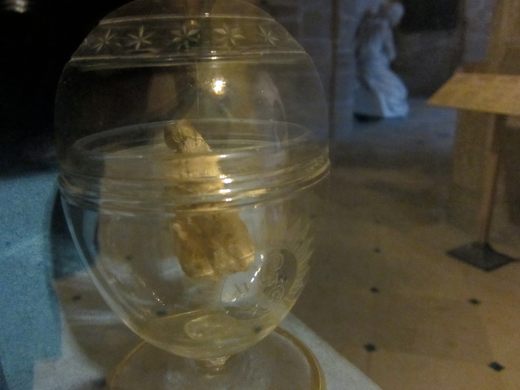
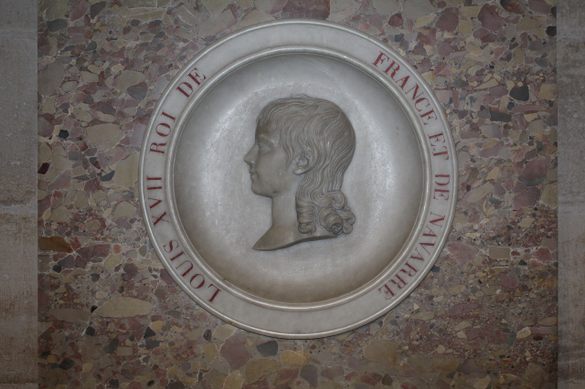
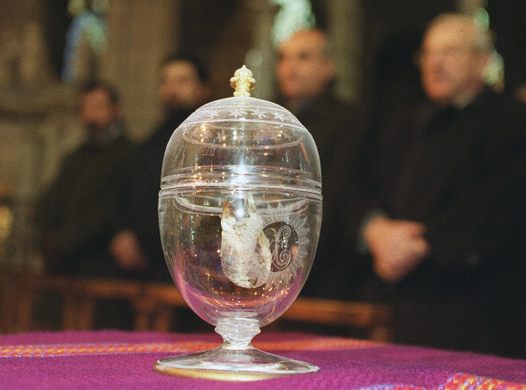
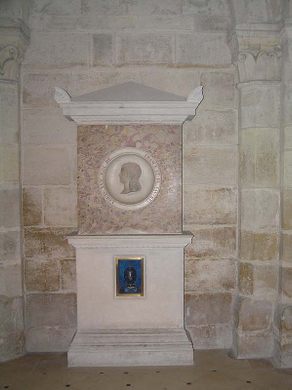
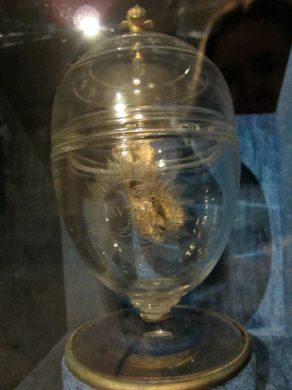
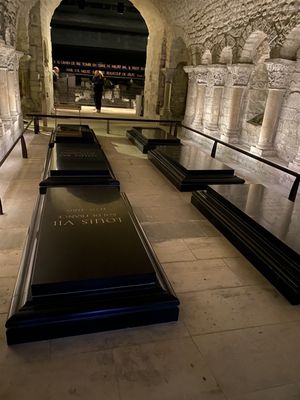
"Contained in a crystal jar in the crypt of the Bourbons in the bottom of the Basilica of Saint-Denis just north of Paris, the small withered heart is kept as a relic of Louis XVII, who died mysteriously in the French Revolution. After his father, Louis XVI, was beheaded at the guillotine in the Reign of Terror, the young dauphin, who was kept in the Temple Prison away from his mother Marie Antoinette, was only briefly the official king, and of course never crowned. It’s believed he died in 1795, but it was only years later, and after several impostors attempted to claim his identity, that it was proven. The heart was sliced out by a surgeon the day after Louis XVII’s death and passed around for years, the alcohol it was submerged in eventually evaporating and leaving just the mummified heart. It arrived at the basilica in 1975. The basilica itself has long been the burial place for the French monarchy, although during the Revolution all of the tombs were opened and their contents tossed into a couple of mass graves. These tangled bones have since been moved to an ossuary in the same crypt where the dauphin’s heart is on display.  Nearby, the remains of the dauphin’s parents, Louis XVII and Marie Antoinette, are interred beneath slabs of marble. (There was really not much left of the guillotined corpses as they’d been buried under quicklime, but the bones and bits of grey matter and a lady’s garter belt were later collected when the Bourbons briefly returned to power in France.) A DNA test with a lock of Marie Antoinette’s hair definitively proved that the heart was of someone related to her, and now the preserved organ is kept beneath a cenotaph showing the dauphin’s young face and curly hair." - ATLAS_OBSCURA

https://www.atlasobscura.com/lists/preserved-hearts
Getty Images/ FRANCOIS GUILLOT
Basilica Cathedral of Saint Denis
@atlasobscura
4,908 Postcards · 2,018 Cities

9 Places to Experience the Turmoil of the French Revolution

"Contained in a crystal jar in the crypt of the Bourbons in the bottom of the Basilica of Saint-Denis just north of Paris, the small withered heart is kept as a relic of Louis XVII, who died mysteriously in the French Revolution. After his father, Louis XVI, was beheaded at the guillotine in the Reign of Terror, the young dauphin, who was kept in the Temple Prison away from his mother Marie Antoinette, was only briefly the official king, and of course never crowned. It’s believed he died in 1795, but it was only years later, and after several impostors attempted to claim his identity, that it was proven. The heart was sliced out by a surgeon the day after Louis XVII’s death and passed around for years, the alcohol it was submerged in eventually evaporating and leaving just the mummified heart. It arrived at the basilica in 1975. The basilica itself has long been the burial place for the French monarchy, although during the Revolution all of the tombs were opened and their contents tossed into a couple of mass graves. These tangled bones have since been moved to an ossuary in the same crypt where the dauphin’s heart is on display.  Nearby, the remains of the dauphin’s parents, Louis XVII and Marie Antoinette, are interred beneath slabs of marble. (There was really not much left of the guillotined corpses as they’d been buried under quicklime, but the bones and bits of grey matter and a lady’s garter belt were later collected when the Bourbons briefly returned to power in France.) A DNA test with a lock of Marie Antoinette’s hair definitively proved that the heart was of someone related to her, and now the preserved organ is kept beneath a cenotaph showing the dauphin’s young face and curly hair." - ATLAS_OBSCURA

https://www.atlasobscura.com/lists/bastille-day-french-revolution
Getty Images/ FRANCOIS GUILLOT
Basilica Cathedral of Saint Denis
@atlasobscura
4,908 Postcards · 2,018 Cities

The Ultimate Guide to Scattered Body Parts

"Contained in a crystal jar in the crypt of the Bourbons in the bottom of the Basilica of Saint-Denis just north of Paris, the small withered heart is kept as a relic of Louis XVII, who died mysteriously in the French Revolution. After his father, Louis XVI, was beheaded at the guillotine in the Reign of Terror, the young dauphin, who was kept in the Temple Prison away from his mother Marie Antoinette, was only briefly the official king, and of course never crowned. It’s believed he died in 1795, but it was only years later, and after several impostors attempted to claim his identity, that it was proven. The heart was sliced out by a surgeon the day after Louis XVII’s death and passed around for years, the alcohol it was submerged in eventually evaporating and leaving just the mummified heart. It arrived at the basilica in 1975. The basilica itself has long been the burial place for the French monarchy, although during the Revolution all of the tombs were opened and their contents tossed into a couple of mass graves. These tangled bones have since been moved to an ossuary in the same crypt where the dauphin’s heart is on display.  Nearby, the remains of the dauphin’s parents, Louis XVII and Marie Antoinette, are interred beneath slabs of marble. (There was really not much left of the guillotined corpses as they’d been buried under quicklime, but the bones and bits of grey matter and a lady’s garter belt were later collected when the Bourbons briefly returned to power in France.) A DNA test with a lock of Marie Antoinette’s hair definitively proved that the heart was of someone related to her, and now the preserved organ is kept beneath a cenotaph showing the dauphin’s young face and curly hair." - ATLAS_OBSCURA
https://www.atlasobscura.com/lists/preserved-body-parts
Getty Images/ FRANCOIS GUILLOT
Basilica Cathedral of Saint Denis

Przemyslaw K.

Google
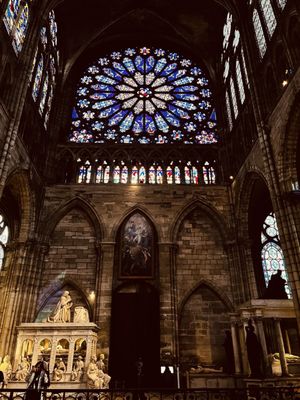
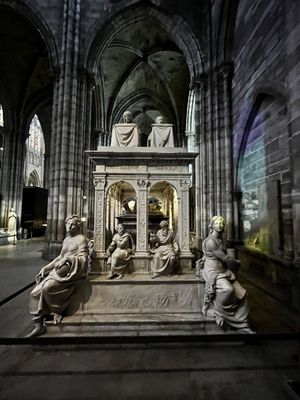
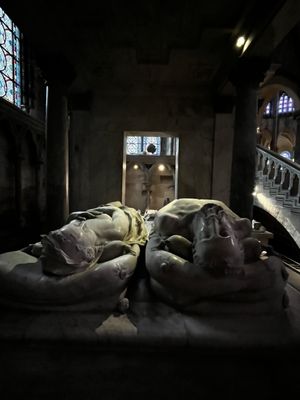
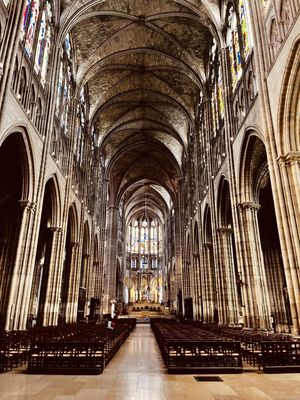
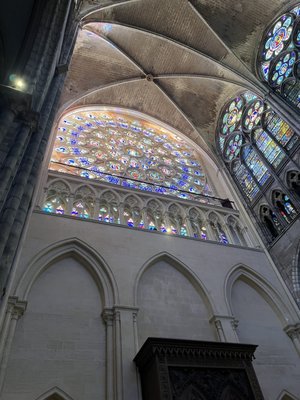
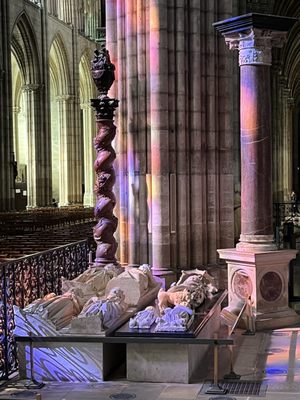
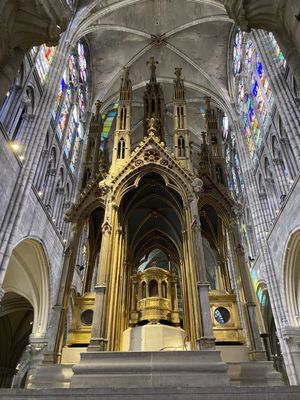
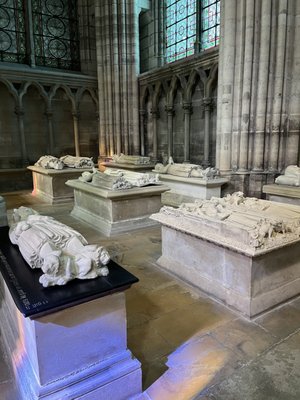
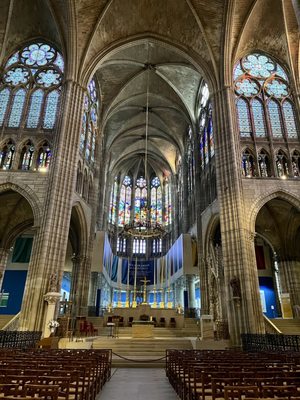
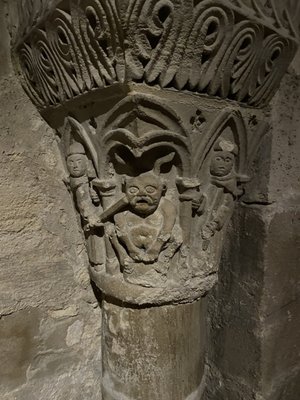
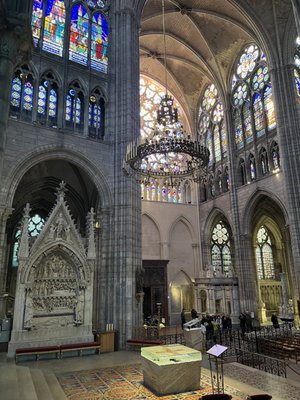
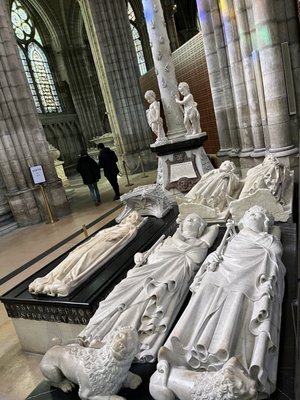
I visited the Basilique-Cathédrale de Saint-Denis ladt year and really enjoyed it. The building has an amazing past. What stands today mostly comes from the 12th–13th centuries, when the choir completed in 1144 became the first structure to use all the key elements of Gothic architecture. But the site goes back much further. It began as a shrine built over the tomb of Saint Denis, the first bishop of Paris, and over time it became a major royal abbey and the burial place of many French kings and queens. After centuries of changes and damage, it was finally restored and recognised again as a cathedral. Inside, the first thing you notice is the light. The tall stained-glass windows fill the space with colour, and the high arches make everything feel open. The royal necropolis is the highlight for many visitors. It holds more than seventy tombs of French kings and queens, including famous ones such as Dagobert I, Henri II and Catherine de’ Medici, Louis XII and Anne of Brittany, and memorials for Louis XVI and Marie-Antoinette. The stone sculptures are detailed and give you a clear sense of how people looked and dressed in different centuries. The main altar stands above the area traditionally linked to the tomb of Saint Denis. Around the altar you see the oldest part of the church, the crypt, where the early history of the basilica began. The choir behind the altar is one of the first examples of true Gothic architecture, and walking around it you notice how the columns and windows were designed to bring in as much light as possible. There is also plenty to look at as you move through the chapels, including the carved choir stalls, the rose window, and quiet corners with older stonework. I enjoyed taking my time in the ambulatory, where the stained glass changes colour as you walk. Entry is normally €17 from Tuesday to Sunday and €11 on Mondays. Many visitors can enter for free, including under-18s, people aged 18–25 from the EU or who live in the EU, and disabled visitors with their carers. Audio guides and short free tours are also available. It’s a peaceful place filled with history and beautiful details, and I left feeling like I had discovered a side of France that many travellers miss.

Seimen B.

Google
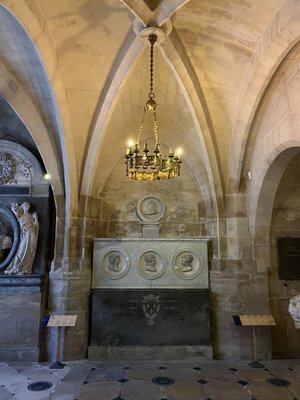
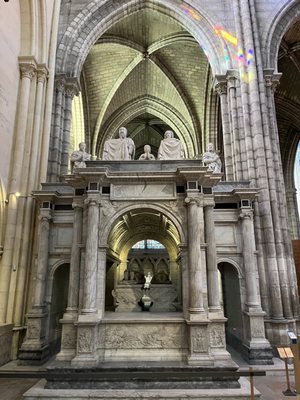
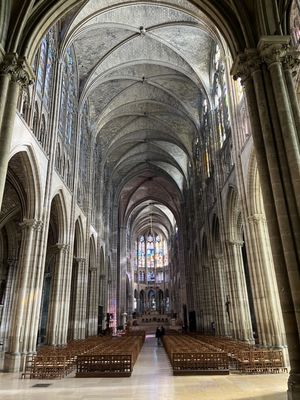
Impressive church and since the 7th century the burial site for nearly every French monarch (43 kings, 32 queens, and other royalty). It is also the birthplace of Gothic Architecture as in the 12th century (c. 1135–1144), Abbot Suger directed a major renovation in which he incorporated key architectural innovations like the pointed arch, ribbed vaults, and extensive stained-glass windows to flood the interior with light. This design became the blueprint for cathedrals across Europe. During the French Revolution (1793), the basilica was secularized and its royal tombs were desecrated, with the remains of the monarchs exhumed and dumped into common graves. Among them King Louis XIV, King Louis XVI and his wife Marie Antoinette. Louis XVI and Marie Antoinette were beheaded by guillotine during the French Revolution in 1793 at the Place de la Révolution (now Place de la Concorde) in Paris. Their bodies were then dumped in quicklime in the Cimetière de la Madeleine In 1815, after the Restoration of the monarchy, the remains were exhumed but only fragments in poor condition remained which are now in two sober graves. There is a splendid sculpture of them both in the church The remains of Louis XIV and other kings, queens and other royalty were recovered from the mass graves of the revolution, identified in so far possible and placed in two ossuaries in the basilica's crypt. For Louis XIV there is a cenotaph Entry is € 17,- but that is well worth it as you get a lot of French history and at the end there is an interesting small artisan village with trades related to the church restoration and a large video presentation.

Elias V.

Google
Extremely beautiful windows in a different style than many other churches. Most of the windows have recently been renovated so the light in the church was amazing. Only part of the church demands an entrance fee. So it is worthwhile even if you do not want to pay the fee to see the front of the church.

david E.

Google
Comprehensively wonderful. French history. Beautiful architecture. Very much worth a visit even if you are only remotely interested

Dan

Google
A very odd woman started singing some religious songs when we were in one of the tiny crypt. You know, those fanatics who stand in the corner in their trance with closed eyes. I met these people before in old Mexican pyramid but Not sure what kind of energy this lady was looking in such place. it looked stupid and scares kids and other visitors. However it made me feel like I am still mentally not bad. The basilica itself is very interesting place especially if you familiar with French history and royal dynasties.

pts P.

Google
What an Amazing Building!!!!! This was perhaps the First Truly Gothic building. It has linking elements to romanesque ( a few Romanesque heavy , thick walls with no or small windows) in a few areas- but then- its absolutely GOTHIC!!!! i cant helpbut wonder if we are seeing later Gothic improvements on the original structure. There are repairs and partial renovations that make me wonder. A 5 star for ANY ARCHITECT or Civil Engineer!!!!!!

Pedro Q.

Google
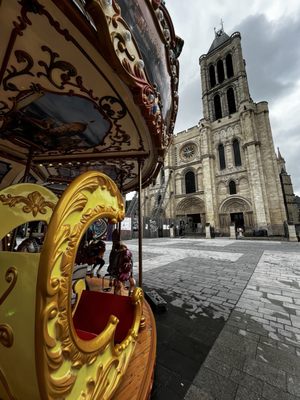
A religious building on the outskirts of Paris. The area where the basilica is located is pedestrianized, so be sure to find a space around it or in a covered parking lot (if you're driving). This basilica is a jewel of medieval art history and the Early Gothic architectural style, as well as the final resting place of the Kings and Queens of France and home to the relics of the patron saint of the Paris region. If you're passionate about Gothic art or royal funerary monuments, the Basilica of Saint-Denis is the place to see. The people who work at the ticket office are really nice and helpful. Small downside: I think that the model of the basilica, which is located near the toilets (in the building next door) should be located either in the part of the necropolis or in the religious space next to the explanatory panel on the walls or the screen which explains the history of the basilica.

G M.

Google
This cathedral is exquisite. It represents the birth of gothic architecture. The necropolis which you pay to enter ( the church is free) has dozens of queens and kings buried here. Their statues and burial sculptures are fascinating. It is well worth the €11 entry fee. Toilets available once you’ve purchased tickets.
google avatar

Joanna T.

Yelp
If you love art , history or architecture At Denis should be on your shortlist. I have regrets that it took me so long to get here because the church is awesome! It's a bit of a metro ride from the center but worth the time. Entry is €10 which includes all the crypts and the choir. If you don't want to pay you can still enter the nave but you miss those most interesting things. So the church itself is absolutely gorgeous - known as the first truly Gothic building. The choir is stunning - just flooded with light and full of beautiful stained glass. I can only imagine how awed the medieval attendees were because it's still pretty impactful. The crypts & disambulatory are full of the graves of the French kings going back to the 400's, along with many other royal queens, children etc. There is lots of really interesting tomb art, showing how people looked and dressed. The archeological crypt is king of creepy - reminded me a bit of the catacombs. Definitely worth taking the time to see this gorgeous church!
google avatar

Nola G.

Yelp
The Basilica of Saint-Denis is located just north of Paris in the city of Saint-Denis. This is easily accessible by Metro and is faster and cheaper than sitting in traffic. The building is considered to be the first structure to employ all of the elements of Gothic architecture. The necropolis contains the tombs of the French Kings from nearly every king from the 19th to the 19th century. The Queens where crowned at Saint-Denis. I have historically documented lineage to several people in this Basilica which was why I visited. The cathedral is gorgeous. The Pass Sanitare was required to enter and everyone wore masks. There is a €9.50 charge to see the tombs.
google avatar

Kevin T.

Yelp
Anyone looking up this attraction on Yelp will probably already know just what to expect from the Necropolis here. Like England's Westminister Abbey, the St. Denis Basilique is the official burial spot for France's monarchs dating back to the 7th Century. You can read the history at the Cathedral's website, but in short, what we see today is much how it has always been with one big exception: all the bones in the crypts have been removed. During the French Revolution, the crypts were all emptied, perhaps over spite, or searching for valuables left with the monarchs, and their bones piled in a open pit nearby. Some years after the revolution, the bones were re-interred in an ossuary below the altar that you can see with the names of all those present. What remains or the visitor today, are the amazing tomb carvings that were not destroyed. Many were fashioned from the monarchs death masks, so you can not only see how they sort of looked, but also, their overall figure, i.e. small, tall, stout, frail, etc. The cathedral itself offers a variety of parts to the self-guided tour. Be sure to drop a couple extra euros in for the audio guide (available in several languages) which will give you the insight an details as you move about. The tombs are all arranged with easy access, marked by name and noted with details in the audio guide. Some tombs are quite grand, such as Francis I, so it is difficult to get as close as you can compared to others. You can only view him and his wife from the side. If you are a lover of history this is a must see attraction. A must see. Unlike Westminister where picture taking is strictly prohibited, you are allowed to photograph here. Easy access from the metro station, the Cathedral faces a square that is often filled with a market filled with local merchants just as it has for the last 1000+ years. 5 ++ Stars.
google avatar

Shannon M.

Yelp
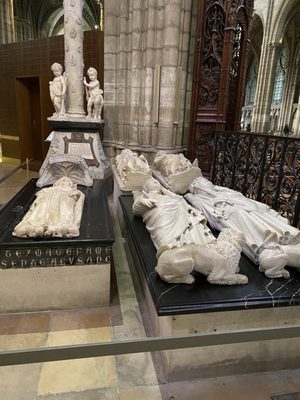
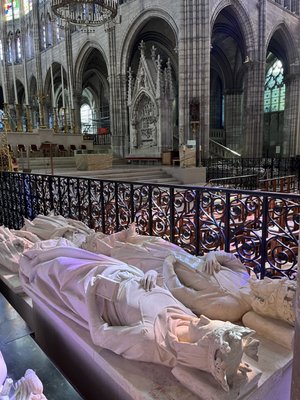
As opposed to the let-down of Notre Dame, Saint-Denis turned out to be one of the highlights of our trip: historically, artistically and for uniqueness value. Saint-Denis is the oldest Gothic cathedral, and is also the necropolis of the French royalty and "men of note." Royals all the way back to Clovis, and up through Louis XVI & Marie Antoinette, are buried here. Almost all have marble likenesses of the royal figures in question lying atop the crypts, and there were some family mausoleums attended by symbolic figures, sometimes with the family represented on top as if seated there. It's fun to compare sculptures: some have bare feet, some don't; some have fairly plain clothes, some are pretty decked out (see Catherine de Medici); they've got different accessories -- one of the reclining statues has two dogs at her feet. The architecture is every bit as beautiful as Notre Dame, with the same types of Gothic arches, vibrant stained glass windows including a rose window, flying buttresses, etc.) Do not miss this! If you are going to visit a church on your trip to Paris, make it Saint-Denis.
google avatar

Raymond C.

Yelp
Be sure to get the guided tour: Charlotte does the English tours and did a marvelous presentation. Because so few English speaking visitors attend, you may get your own private tour! The relics and artifacts are steeped in French history, so this is definitely a great find on my third trip to Paris.