KI-NRT
Google
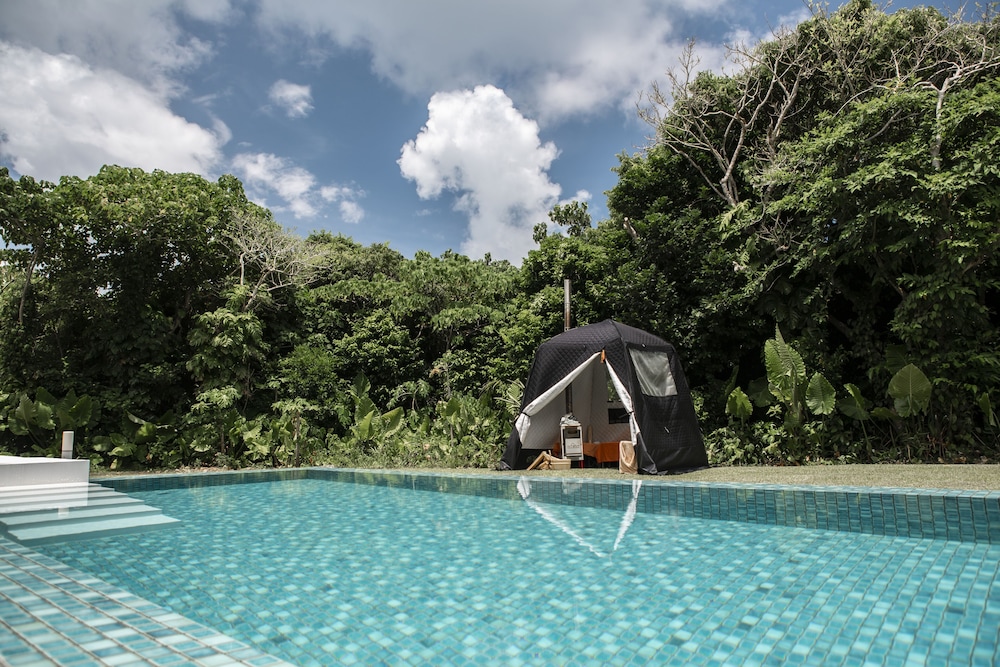
We visited Jusandi for the first time in five years - we would not have returned to Jusandi if not for the chance to experience Chef Hirose's cooking one last time before his departure from Jusandi (he is reaching mandatory retirement age, and will be leaving the property in March 2026.) Some memories are best left untouched, but after having dinner there four nights in a row on our previous stay, we were confident that the food had genuinely been exceptional and not just colored by nostalgia.||||Jusandi occupies a plot of land not far from the sea - only a few hundred meters from the nearest beach - but from anywhere on the property, including the villas, there is essentially no sea view. The resort is surrounded by dense, jungle-like vegetation, which has been left intact rather than cleared to open up vistas. This is probably for the best, as the property faces north, where winds can be fierce; the thick greenery likely provides a natural buffer from the elements. On our first visit, our villa had a partially obstructed ocean view, but this time there was none to speak of. That said, we enjoyed the short walk through the jungle to a small, secluded beach in a nearby cove. It is also the starting point for swims to the so-called "blue cave," where, in ideal conditions, the water glows a deep blue. We have never actually gone into the cave - time constraints, often-rough seas on the island's northern side, and the fact that we have already visited plenty of brilliant blue waters in places like Belize, the Philippines, and the cenotes of Mexico made it easy to pass this up.||||One of Jusandi's most appealing visual elements is its architecture. The structures are predominantly white, evoking Mediterranean villages and lending the property a soothing, minimalist feel. More wood might have added warmth, but the simple white concrete has aged gracefully, reminiscent of certain properties in Santorini or along the Amalfi Coast. Each of the five villas has a slightly different layout dictated by the land, and on our first stay we found Maani, our one-bedroom villa, narrower and more constricted than its 60m² footprint suggested. This time we stayed in the 100m² two-bedroom pool villa, Yarabu, which addressed some of those spatial issues - even if much of the additional area is devoted to the second bedroom. The squarer configuration makes the living room, which is probably not dramatically larger than those in the one-bedroom units, feel brighter and more open. It is also worth noting that Ishigaki has virtually no natural hot springs, due to geological conditions that do not favor onsen formation. In any case, Okinawa's generally warm climate means that bathing culture here leans far more toward showers than soaking tubs.||||Our main reason for returning, however, was the food, and on that front the experience sadly did not live up to the high standard we remembered from five years ago. The menus felt short on imagination, and both the selection and quality of certain ingredients were underwhelming. The pasta course, for example, was a simple tomato sauce with sausage and ham. This was followed by sautéed leopard grouper with bagna cauda, and then panko-crusted pork with mustard sauce. The progression was heavy and not especially creative. For the fish, something like an acqua pazza preparation would have been preferable - lighter yet still full of umami. Looking back at photos from our previous stay only highlighted the gap: fried whitebait and cabbage with karasumi (salted mullet roe), ravioli with snow crab in a delicate dashi sauce, spaghetti with oysters and rape blossoms in a minimalist but outstanding salt-and-dashi broth, and a superb cold pasta of capellini with fresh tomato sauce, spicy cod roe, and caviar. By contrast, the squid ink risotto with thin strips of squid on this visit was good but hardly original.||||To be fair, there were bright spots. A dish of blackspot tuskfish and potato brandade, served with tuskfish jelly, caviar from Gifu Prefecture, and scallions, all tied together with kelp stock, was a terrific way to begin dinner. A carpaccio of tuna and ruby snapper with assorted land and sea vegetables also did a fine job of whetting the appetite. Breakfast was another high point: an Okinawan spread of island fruits, cold noodles with mozuku (brown seaweed) in a vinegar dressing, Ishigaki pork with poached eggs and long onions, and a clear soup with aosa seaweed showcased local ingredients in a way that was satisfying and flavorful without being heavy.||||Was the detour worth the extra flight, car rental, and accommodation costs, plus the time required to fit Jusandi into our itinerary? The experience did not quite match our hopes, but it was not a major ordeal to bolt on an extra day at the end of our Okinawa trip, and we enjoyed the chance to relax at Jusandi and wander around the surrounding area.||||As for what comes next, both for Jusandi and for Chef Hirose, the future is uncertain. He mentioned having a son in Fukuoka and hinted that he might relocate there, perhaps to open a restaurant in the city. Jusandi, meanwhile, has yet to find his successor, and there is no clarity about what sort of cuisine will be offered going forward. That single decision will likely shape Jusandi's prospects more than any other factor.