Sienna K.
Yelp
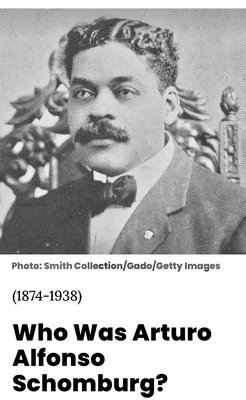
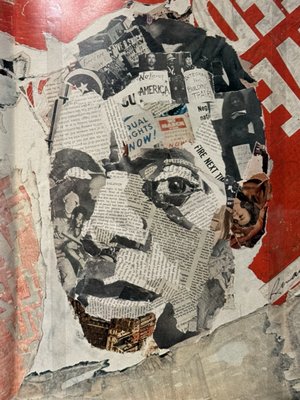
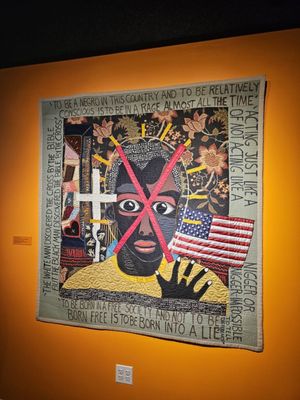
When the Schomburg Center for Research and Black Culture reopened after some extensive renovations, they launched their new programs with an exhibition entitled, "Stereotypes and Humantypes," exploring in part of how the 19th century stereotypes of African Americans led to a history of African Americans trying to refute these racist remarks by reclaiming their own identity and defining for themselves how African Americans should be portrayed. It wasn't just an incredibly relevant exhibition, but an ironic one at that, as the Schomburg Center is the legacy of one early Arturo Schomburg, who was once told by his teacher, "Black people have no history, no heroes, no great moments."
Not only is the Schomburg Center is one of the largest research centers for black culture in the world, it is also a great piece of living history, for it has been the intellectual epicenter for all the evolving movements in Harlem.
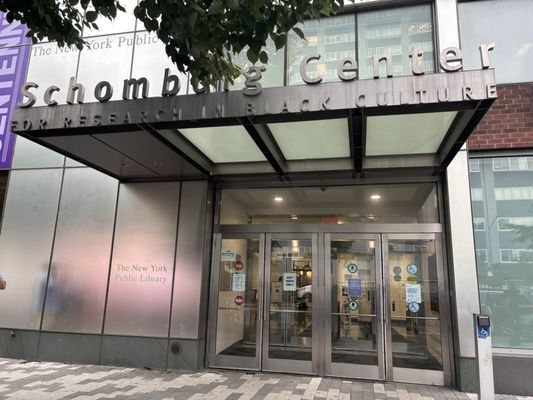
The library was rebuilt during the 1980s by the J. Max Bond Jr., one of the most, if not the most, esteemed African American architects (his other big design has been the King Center in Atlanta, and his firm had been asked to design the ground zero memorial in 2004). Bond's works emphasize the role of architecture in integrating the community, and this achieved in the design of the Schomburg library by the rather unassuming brick front. Though undeniably modern and sleek, Schomburg's brick front, as designed by Bond Jr., blends in with the architecture of the area as if a continuation (and not standstill) of the Harlem's rich history.
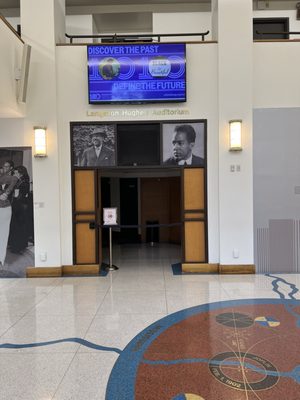
I had come to the Schomburg because I've been meaning to see the Aaron Douglas "Aspects of Negro Life" murals for a long time now. While I was at first impressed by the extensive collection, I also soon got tired of being lost in the library. I'm not sure exactly how much of the interior was remodeled since Bond's original design, but Schomburg had renovated the inside of the museum, altering the architect's original plans, and with the current plan of the museum, things are not only hard to find, but the flow of some of the exhibitions is disrupted as exhibitions are split up into different rooms flung across various floors of the library. Worst, when I asked people for what I needed to find, I got largely blank stares.
I finally found the murals in the octagonal reading room, and was about to go home, when I read in passing that Saturday was the only day the Photography collection was open to the public. Intrigued, I went upstairs to the third floor. As soon as I got off a woman barked at me, "WHERE are you going?!" Not a good start. But I'm glad I did. The Photography collection was housed in an unassuming quiet room; a part of me had expected some sort of gallery style presentation of a their collection, and was a bit surprised to find a research facility. The nice man at the counter asked me if what I needed to study. "Crap," I thought. "I got nothing." But somehow after two seconds of staring at him blankly, my brain kicked in and blurted out "James Van Der Zee's photos."
I sat and waited for a few minutes as the librarian went off to go find the pictures. I don't know what I was expecting, but it definitely wasn't what I got-- an experience that pretty much made my entire weekend. They came up with two large boxes of Van Der Zee's photos. It was an amazing experience to touch and go through so many of Van Der Zee's absolutely breathtaking photos, much of them that I've never seen before, and probably can't see elsewhere. The first box contained mostly portraits, for which Van Der Zee gained his fame, while the second has mostly the gorgeous cityscape prints that document the evolution of Harlem. Sitting there, shifting through photos that Van Der Zee himself may have touched and signed, I quickly forgot about the rainy walk here to the Schomburg, getting lost in the library, and everything else on my mind.
The Schomburg is definitely worth a visit. I can't imagine a better resource for research in the field; and even if someone, like I, had no academic pursuits, but only curiosity, the Schomburg is still a great place to spend an afternoon. Really, go check out the beautiful exhibitions, collection of paintings, the Douglas murals, and of course, the photography collection. The Schomburg is a great monument to the efforts of people who went against the prejudice of black culture lacking history or depth; in fact, when Arturo Schomburg was later asked what exactly was black history, he replied, "What you're calling African history, Negro history, are the missing pages of World history" -- a brilliant rebuttal to the remarks of those like his 5th grade teacher.